
Every facilities management team has a version of the same problem. Work orders come in through multiple channels—a maintenance request form, a phone call to the front desk, an e-mail to the FM inbox, a report submitted through a tenant app. Someone on the team reads each one, figures out what it is, decides how urgent it is, assigns it to the right technician or vendor, and sends a confirmation. Then they do it again for the next one.
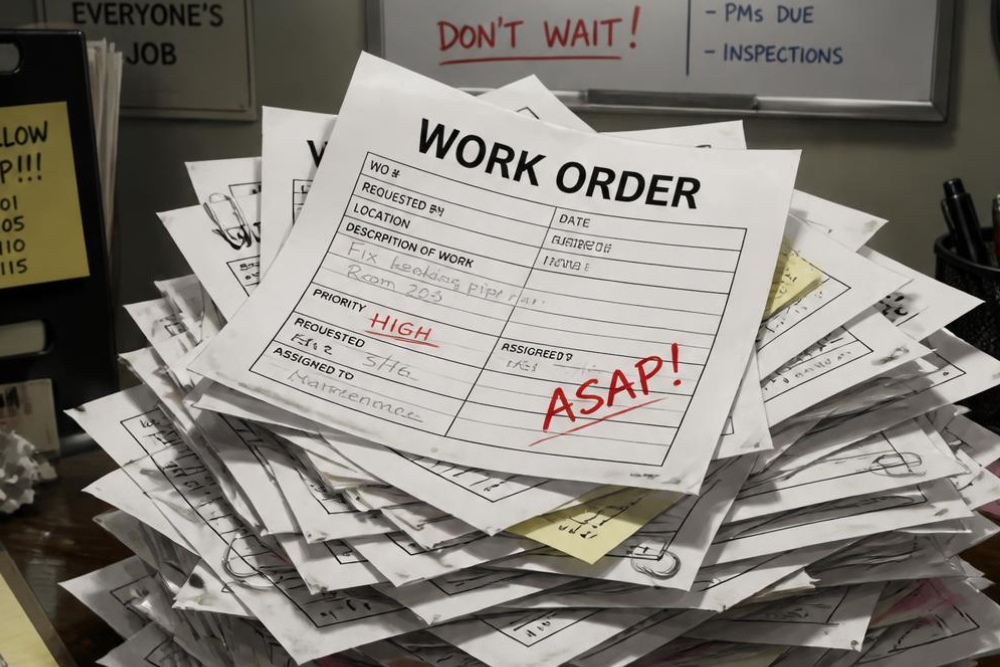
For a small team managing a single building, this is manageable, if not enjoyable. For a team managing a campus, a portfolio of commercial properties, or a large institutional facility, it becomes the job that never ends. And because it happens continuously throughout the day, it is also the job that is hardest to staff for: You need enough coverage to respond promptly, but the volume is uneven and the work is not complex enough to justify dedicated headcount on its own.
This is the triage problem in FM operations, and it is where artificial intelligence (AI) is beginning to make a measurable difference—not by replacing FM professionals, but by handling the intake and routing decisions that consume their time before they ever touch actual facility work.
What AI Triage Does—and Does Not Do
When people hear “AI” in an FM context, they often think of predictive maintenance: systems that monitor equipment sensor data and flag a likely failure before it happens. That is a real capability, but it requires connected sensors and significant infrastructure investment. AI triage is different and considerably simpler to deploy.
AI triage operates on the work order request itself—the text of a complaint or service request—and performs three functions that currently require a human: classification, priority assignment, and routing.
Classification means identifying what type of issue has been reported. A request that says “the AC in conference room 4B isn’t working” is an HVAC issue. One that says “there’s water dripping from the ceiling in the east corridor” is a plumbing issue with potential secondary consequences. Classification is largely a language task, which is exactly what current AI handles well.
Priority assignment means applying your team’s existing rules to the classified issue. A water intrusion incident may trigger an immediate response regardless of time of day. A burned-out light in a private office may be a next-business-day item. These rules exist in every FM operation—AI applies them consistently and instantly, without someone needing to read and decide.
Routing means sending the work order to the right person or vendor, with the relevant context included. An electrical issue goes to the licensed electrician on duty. A cleaning request goes to housekeeping. A structural concern goes to the FM manager for review before dispatch.
What AI does not do is make judgment calls outside its defined rules, handle novel situations it has not been trained to recognize, or replace the FM professional who manages vendor relationships, oversees compliance, and knows that the “HVAC issue in the east wing” is actually a recurring problem tied to a specific air handler that needs a longer-term solution. Those decisions remain with people. The routing work does not have to.
How to Classify Your Work Orders for Automation
The practical starting point for any FM team considering this approach is not a technology purchase. It is a classification exercise.
Pull 60 to 90 days of closed work orders from your CMMS and categorize them by three criteria: issue type, priority level, and routing destination. In most operations, this analysis reveals that 60-75% of requests fall into a small number of repeating categories—HVAC, lighting, plumbing, access control, cleaning, and general maintenance—that follow consistent routing logic.
These are your automation candidates. The remaining 25-40%—escalations, unusual issues, requests that require site inspection before a decision, complaints with ambiguous descriptions—stay with your team.
Once you have the classification map, you have two things: a clear picture of where your team’s intake time is actually going, and a requirements document for any AI tool you evaluate. You are not asking vendors whether they “do AI.” You are asking whether their system can apply your specific classification rules to your specific work order language and route to your existing CMMS records automatically.
That is a testable question, and the answer tells you more than any demo.
Getting Results Without Replacing Your CMMS
One concern FM managers often raise is that adding AI to the intake process means adding another system that does not talk to the existing CMMS. This is a legitimate concern. An AI that creates work orders in a separate database and requires manual transfer back into your primary system has not solved the triage problem—it has added a step.
The integrations to ask about before any evaluation: Can the system read incoming requests from your existing channels (email, web form, phone transcription) and create records directly in your CMMS? Can it update work order status automatically when a technician marks a task complete? Can it route to vendors outside your organization, not just internal staff?
These questions filter out tools that automate intake in isolation from tools that actually change your workflow. The former are demonstrations. The latter are solutions.
FM teams that have made this transition report consistent outcomes: intake time drops, priority errors decrease, and follow-up requests from requestors—the “did anyone see my e-mail?” contacts—fall sharply because the acknowledgment goes out automatically the moment the request is classified. The work order queue becomes something the team manages rather than something that manages them.

Ralf Klein is a founder at Triad, an AI automation agency that builds operational AI agents for facilities management and property operations teams.