

The best facilities managers don’t just keep buildings running—they help people succeed, too. Kyle Rager is proof of that. Early in his career, mentors recognized his potential and encouraged him to take on bigger challenges. Now, after more than 15 years in the profession, he believes one of the most important responsibilities of an FM leader is investing in people. In fact, when asked what he’s most proud of, his answer had nothing to do with buildings or budgets. Instead, he pointed to “people development” and encouraged today’s leaders to “train the next generation of FM talent.”
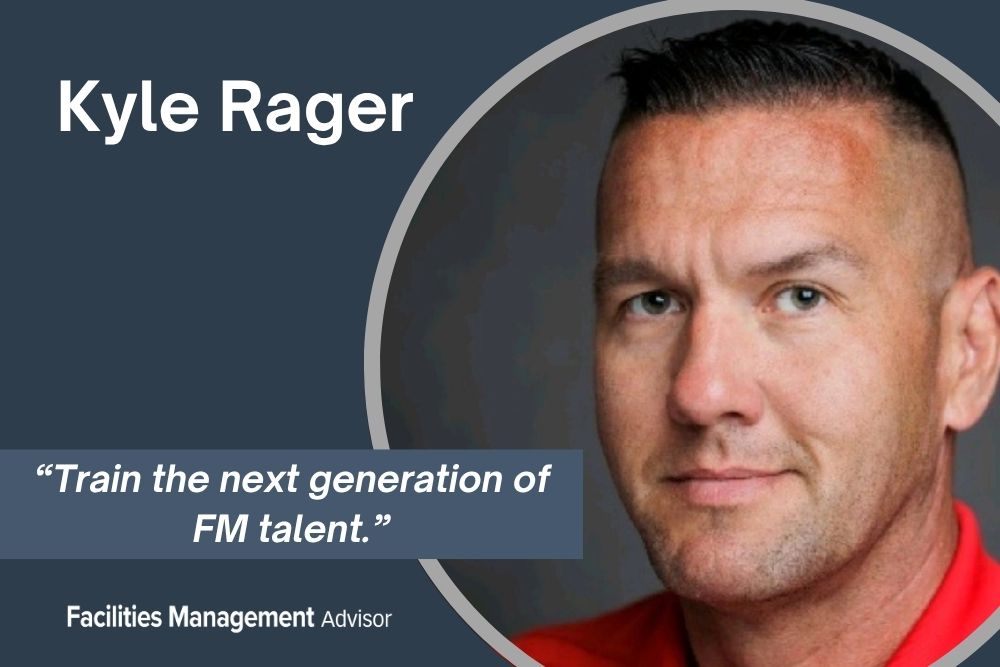
Rager’s own professional journey continues, as he’s currently transitioning to an FM role at a new organization. Most recently, he served as a regional facilities manager for major commercial real estate services firm CBRE. Before that, he was a facilities leader at ROSEN USA and Baker Hughes. He also proudly earned his CFM (certified facilities manager) accreditation from IFMA.
To learn more about Rager and his take on industry issues, please read the “Faces of Facilities” interview below:
How did you get your start in the field?
I tell folks I started my FM journey in 2005 with TDIndustries in Houston as a sheet metal helper, building HVAC infrastructure from the ground up. In 2008, I was asked to learn and take on “startup technician” duties where now I was performing the initial startup and commissioning of the new systems. I maintained the critical systems while the new owner took over and learned their facilities.
In 2013, I transitioned to a facilities coordinator role with Baker Hughes. My primary function was to be the Rankin Road headquarters’ main building automation system (BAS) engineer, ensuring the system that runs the site’s HVAC systems was optimized and functioned as design. With the fluid economy of the oil and gas (O&G) industry, my role evolved to a more traditional facilities coordinator, where I assumed the day-to-day responsibility of all site operations: janitorial, security, cafeteria, engineering, etc.
In 2019, post-merger between Baker Hughes and GE Oil and Gas, our department was transitioned to CBRE to deliver integrated facilities management services to the client. There I was given the role of facilities manager for the world headquarters for Baker Hughes, a 1+ million square-foot site with over 2,000 employees and 11 buildings. We managed through the soon-to-come COVID pandemic while ensuring site safety and compliance.
In 2021, I took a role of head of facilities for ROSEN USA, a pipeline inspection company. There we (my team) worked to establish solid facilities standards, processes, and policies. That included rolling out a CMMS system, establishing the organization’s first P&L operating budget, and even self-performing the installation of the U.S. sites’ first BAS in Columbus, Ohio, and Houston, Texas. In departing ROSEN, our last achievement was working with the organization’s safety and quality department in producing eight formal facilities policies where now the organization knows what they should expect from a professionalized FM team.
Who has been your biggest influence in the industry, and why?
My biggest influence in the industry has to be my FM mentor Kirk Bieck. He was the FM of the Rankin Road location at Baker Hughes where I was the facilities coordinator. As mentioned, the fluid nature of O&G led to some reductions in staff, but Kirk recognized my natural ability to leverage my trade skills and showed me the potential. In fact, there was a time when I was left with an option: Choose to remain in the engineering office and just “monitor the BAS,” or leverage my potential and learn what FM really does and how we can impact everything on-site. He gave me the opportunity and grace to learn. If I fell down, I fell forward, and that’s OK.
However, I can’t complete this question without mentioning Jared Hothan, who was my hiring manager when I took the job at Baker Hughes. He also saw potential and hired me from construction and would be the one who opened the door to a world that a 28-year-old HVAC tech didn’t think was possible.
What’s your best mistake, and what did you learn from it?
My biggest mistake is failing at success in times. Staying humble is what I’ve learned. You’re never too high or too low in anything we do. I don’t think I was prepared or really understood what it meant to be an FM leader. Your team naturally adopts your personality or your demeanor, and it’s your responsibility to ensure that any immediate emotion to a problem or escalation doesn’t negatively impact the team. I probably didn’t understand this early on. Not too sure most do.
What are some of the biggest facilities management issues at an organization?
The biggest issues are always finances and budgets. FM is not a profit center, so we always have to validate and justify the need for the expense. The uniqueness of this is that once you’ve gained experience in proposing projects, getting them deferred, and dealing with the impacts, you learn the critical thinking skills that are ultimately a necessity of the job.
Our responsibility is to ensure that organizational leaders fully understand the risks associated with deferring maintenance, upgrades, or capital improvements. When a system ultimately fails or experiences an outage, it is important to remain humble and avoid taking an “I told you so” approach. Instead, we should use those situations as opportunities to reinforce the value of proactive investment, educating leaders on how timely spending, system upgrades, and improvement projects can reduce risk, improve reliability, and support long-term operational success.
What’s your favorite part about working in the industry?
Easy. The “chaos.” You can plan your day—spend hours upon hours thinking what you’re going to do—and in an instant, it all changes. The first emergency call, leak in the ceiling, or tripped breaker can take over. The poem saying “best-laid plans of mice and men” is never truer than when this occurs. Now what we planned to do still needs to be done, but the emergency response, customer service, and being the hero of the moment is where the FMs who succeed separate themselves.
What changes would you like to see in the FM industry?
I would like to see us evolve to more of a critical business partner than a “cost center.” There is so much to FM that a lot of people/organizations do not understand—those who do will get this response. No one tells us when the coffee tastes good, the office climate is comfortable, or all the lights are on. It’s only when the one thing is an inconvenience, and that is OK. I would like to see the innate nature of our trade get to be more understood and recognized.
Where do you see the industry heading in five years? Are you noticing any major trends?
It’s AI driven as with most. Whether it be throwing a spreadsheet into copilot or asking it what are the best actions that should be taken for a problem, the execution still matters. AI isn’t going to fix a toilet or return a BAS to auto. Our ability to embrace AI and not shy away from it will be the difference. Let this resource suggest the solution, but our relationship with our client or internal stakeholders is never going to be taken away.
What are you most proud of?
Easy. People development. As mentioned, Kirk mentored me and would always tell me that when I’m ready to take the chair, he would proudly get up. I feel the same. Train the next generation of FM talent and encourage them to pursue it. You never know where it will lead you.
Do you have any advice for people entering the profession?
Rome wasn’t built in a day. Don’t be too “eager” to progress swiftly. Everything happens as designed and when it’s supposed to. I entered the construction field to provide for my family, and it led to FM. In fact, I would encourage over and over again to enter a trade (plumbing, HVAC, electrical), learn those skills, and be conscious of opportunities along your journey. When I took the leap to join Baker Hughes, it was scary. I didn’t know or have confidence I could perform, but I owed it to my wife and daughter to try. “Take the leap. Have faith in your destination.”
Are you or a colleague an FM professional interested in being profiled for the “Faces of Facilities” series? Please contact Editor Joe Bebon at JBebon@BLR.com.