

Stephen Odom, a senior facilities manager at Papa Johns, believes having a strong background in skilled trades can set you up for success in facilities management—especially when it comes to working under “extreme” pressure.
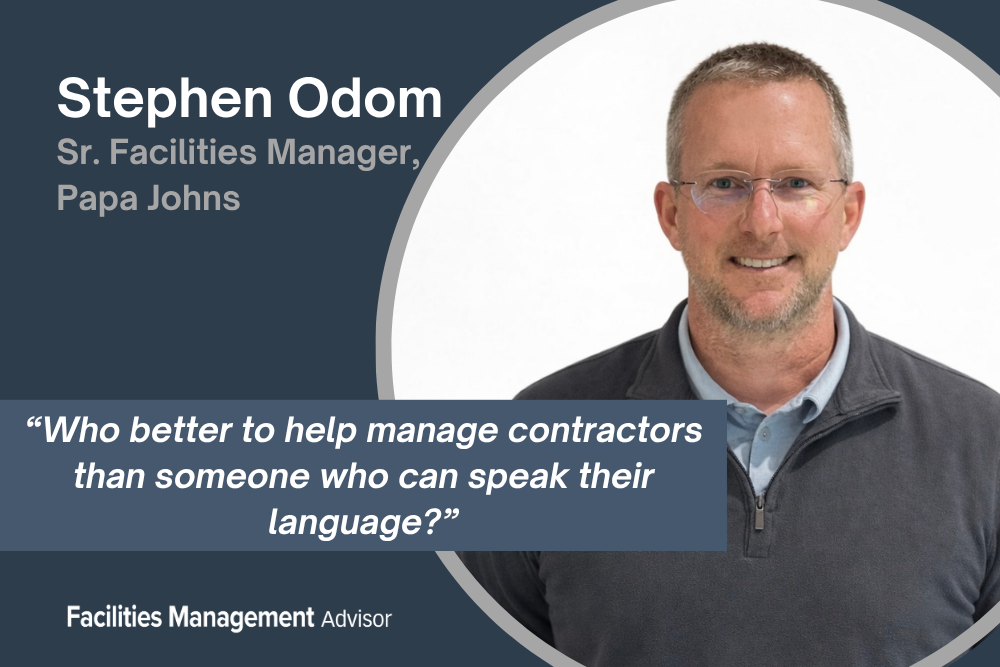
Odom’s own background includes about 20 years in the commercial mechanical industry, with previous roles such as regional HVAC manager, national technical manager, and installation manager. He joined Papa Johns, a major quick service restaurant serving up pizzas nationwide, about a year-and-a-half ago. As senior facilities manager, he directly oversees about 250 sites and has broader responsibilities across the Papa Johns portfolio.
To learn more about Odom and his take on industry issues, please read the “Faces of Facilities” interview below:
How did you get your start in the field?
I started in the mechanical trades in my early 20s, specifically commercial kitchens and retail spaces. I was intrigued with facilities, especially as I gained experience with all the mechanical operations inside commercial spaces. We would have large capital rollouts, and I’d question many of the decisions. I felt these facilities teams could really benefit from someone with deeper technical knowledge.
I managed many different teams and traveled nationally to resolve problems, so it was time to use that experience on the other side of the coin. After all, who better to help manage contractors than someone who can speak their language?
Who has been your biggest influence in the industry, and why?
My biggest influence is a man named Scott. We came up as HVAC/R technicians together, albeit he was a senior tech as I was just getting started. He now manages a large multi-regional refrigeration service department within the supermarket industry. I was so hungry to learn, yet I learned by knowing the why and how, not just the “do this” part. He was very good at breaking down problems in a way I could remember and understand.
Since I met him early on, every step I’ve taken, he’s been there as support and to offer advice, or just a “you’re doing great, brother.” I still call him one of my few close friends today. He’s one of the reasons I’ll tell a service manager to have his tech call me. I like being a resource to try to help the younger generation. Everybody needs someone who will pick up the phone for them.
What’s your best mistake, and what did you learn from it?
I briefly worked at a mechanical contractor in the same commercial spaces industry. I was put in charge of a refrigeration project. All new refrigeration equipment with line sets, evaporators, and condensers. We had a massive amount of copper lines to run through the restaurant. All of this was overnight, mind you—about 2.5 hours away from home for me and the Orlando, Fla., crew. I did my own calculations on refrigerant line sizing and came up with what I was going to use. I’ve done that plenty of times with other capital projects and been right on the money. Plans were not provided for me, but I didn’t push hard for them either—I GOT THIS, right?
We did almost the entire job, 95% done with the Orlando and Jacksonville crews teaming up. Well, the GC came through and all our line sets were the wrong size according to the job plans. At 6 a.m. after close to 24 hours on the clock, we had to run all new copper throughout the entire restaurant. Meanwhile, this location was to open that day. We got it done, but not without being absolutely worn down, limping home with a bruised ego.
From this, I decided that anything that would have my name attached to it—I would be annoyingly persistent and thorough to accomplish the best possible outcome for everyone. This was a moment I let my team down, and I didn’t like that feeling.
What are some of the biggest facilities management issues at your organization? Are there any unique FM challenges?
I would say one of our biggest challenges is proper asset data collection. This is a common problem within facilities, but it’s important to tackle. I don’t think there are many unique problems to address. To reduce the reactive firefighting mode in favor of a carefully planned, strategic capital replacement and maintenance plan. I think that’s something we all have in common; some are just farther along than others.
What’s your favorite part about working in the industry?
Working with the vendors. I’m 100% sure I sound like the parts house guy who thinks he knows everything when they talk to me, but I still enjoy it. I enjoy having thoughtful conversations with them on common problems they see occurring, and ways that we can resolve/reduce—and then scale it.
What changes would you like to see in the FM industry?
I think there is an opportunity to get more leaders from the trades in facilities roles. These are men and women who have performed advanced problem-solving on very little sleep (if any, sometimes), clients yelling at them in person, emergency service after emergency service, and often without even a “good job” for their time they are giving up to “make sure we are up and running right now.”
If you have a person who has worked through the ranks in a mechanical trade, leading teams, dealing with non-stop weekend emergencies and taking flack from us FMs—I think you have someone who fits the bill for a facilities manager very well. These people will be EXTREMELY driven and thankful for the opportunity in most cases. They can operate under extreme pressure.
How can company leaders make facilities management a value within their organization?
It’s all about the data. Our CMMS can pull a cost avoidance number. This is not just rejecting a work order and leaving something broken. It shows how much has been negotiated down or avoided. It could be a vendor accidentally charging extra trip charges, an extra condensate pump, or maybe the cost is above industry average, so we negotiate.
There are other things like working with the operators to resolve an issue without releasing a work order and rolling a truck. When you can show that you’ve saved X million dollars in spending, all while increasing store uptime, that starts to put a little more merit into what we do every single day.
Uptime is the other leg. Anyone can let a place fall apart by denying work orders, but can you save money and contribute to more uptime for a business to provide its product?
Where do you see the industry heading in five years? Are you noticing any major trends?
I see the industry utilizing AI a lot more. It’s what everyone is talking about, and many are utilizing it already. Companies will need to be careful not to make it their only source for a decision but instead utilize it as a valuable tool.
What are you most proud of?
Honestly, I’m proud of being a facilities manager. I set out a long time ago to use my drive and work ethic to put me in rooms that I wasn’t qualified to be in (yet). I went from being a kid covered in dirt, sweating on a 120-degree roof, to helping a company or corporation make smart investments to improve their facilities and operations. I had a vision to use the knowledge/experience I had gained for greater contributions, and I succeeded in that.
Do you have any advice for people entering the profession?
Buckle up. Your brain will feel like Pop Rocks some days, and it can be overwhelming. Start by figuring out what’s overwhelming you and where the bottlenecks are. Then start working on systems that can work with minimal input and free up the bottleneck. Put the work in now, and it will pay off.
If you’re feeling a little hot and bothered while you type up that email, move away from the computer. Grab a soda, play some music, or do whatever calms you. One of the greatest assets of an FM is reacting thoughtfully and measured. This goes back to problem-solving under pressure.
Are you or a colleague an FM professional interested in being profiled for the “Faces of Facilities” series? Please contact Editor Joe Bebon at JBebon@BLR.com.