
Facilities managers are used to wearing a dozen hats—problem-solver, safety officer, IT liaison, compliance expert. But today, that job’s gotten even tougher. Whether you’re running a school, hospital, office, or government building, your to-do list includes safety, air quality, compliance, and keeping everything running smoothly with fewer hands on deck.
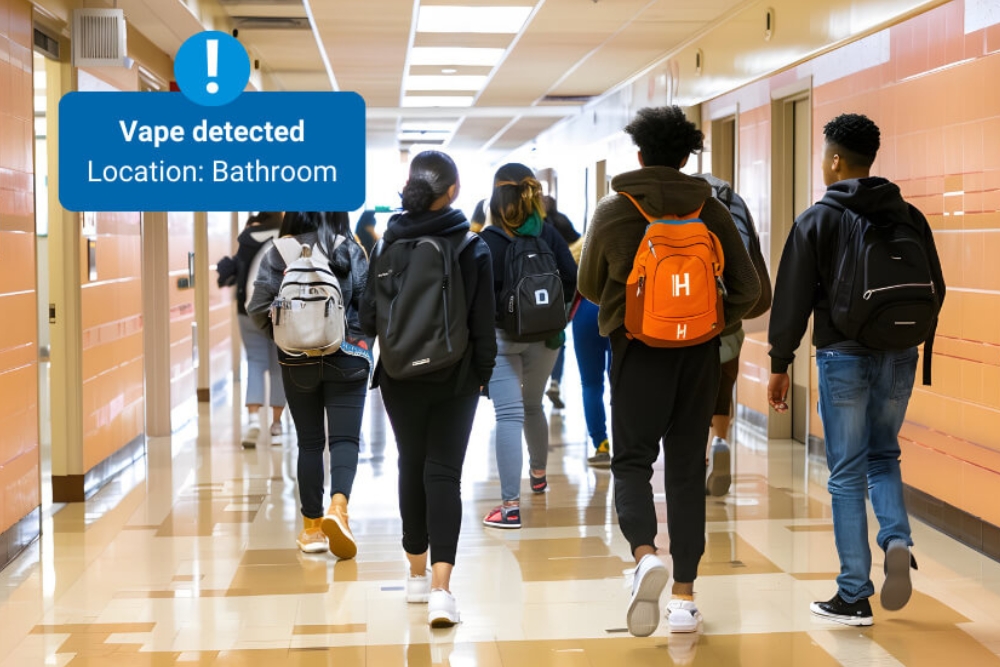
Video surveillance systems have long been a staple of security plans. But today, the smartest systems are doing more than recording video—they’re using sensors to track air quality, detect vaping, monitor noise and motion, and send real-time alerts when something’s off.
Let’s take one example that’s become all too familiar: vaping in schools. We all know you can’t install cameras in the places where vaping tends to occur—bathrooms and locker rooms. But that doesn’t mean you’re powerless to deter vaping in schools. Vape detection sensors give schools a privacy-safe way to spot problems and act fast. When a sensor detects vape aerosol in the air, it triggers an alert and ties that alert to video footage from cameras in the hallway. Video shows who entered and exited the restroom or locker room, and authorities can take action immediately—without violating anyone’s privacy.
That’s not a theory. That’s happening in real schools right now. And it’s needed. According to the 2024 National Youth Tobacco Survey from the CDC, nearly 10% of U.S. high school students are actively using e-cigarettes. Schools now have better tools to catch offenders, prevent incidents, and protect student health.
But the potential of this tech goes far beyond schools. Hospitals are using sensors to monitor temperature changes in operating rooms and pharmaceutical storage. Office buildings are flagging poor air circulation before employees start complaining. Data centers can now detect rising CO₂ levels or equipment-damaging humidity before systems go down.
Here’s the difference that sensors integrated with video surveillance make for facilities managers:
- Speed: Instead of hearing about a problem secondhand, you get a real-time alert. That alert links to camera footage and shows you exactly where it happened and when.
- Clarity: You’re not left guessing whether the HVAC unit failed, a window was left open, or there’s a crowd of students vaping in the restroom.
- Action: You can respond immediately, notify the right people, and avoid escalation or repeat issues.
Sensors are getting smaller, smarter, and easier to deploy. You don’t need a massive IT overhaul to install one. In many cases, it’s as simple as mounting a wireless sensor which connects to your cloud-based video system. From there, you can configure alerts for your facilities staff, your security team, or anyone else who needs to be in the loop.
Some schools start with one wing or one floor and scale up from there. They begin with vape detection and then layer in CO₂ monitoring, temperature alerts, and water leak detection. Every new sensor adds visibility—and makes your job easier.
One of the main benefits of sensors is better overall visibility in your facilities. Facilities managers are expected to maintain high standards with limited resources. A pipe bursts in the basement, a student gets sick from poor air quality, a security concern pops up in an unmonitored stairwell. It’s your job to determine what happened and how to prevent a recurrence.
A smarter surveillance system helps you do both. Cloud video surveillance systems are used in schools, airports, hotels, hospitals, and manufacturing facilities. Every industry has different risks and compliance needs. But the common denominator is context: sensor-integrated video surveillance provides data that give you information about what is happening in your facilities and why.
Instead of relying solely on human reporting, you’re getting objective, real-time signals about your environment. Those signals are connected to video so you can verify what happened without walking the building or watching hours of footage.
It’s a better system for safety, for compliance, and for optimal management of facilities.
Some people hear “surveillance” and immediately think of privacy concerns. That’s valid—but modern systems are built with that in mind. Vape detection sensors don’t record any video. They simply detect chemical changes in the air and send an alert. Cameras pick up the rest—outside of sensitive zones—so staff can take appropriate action with visual evidence.
This is the direction building safety is headed. Not just more cameras, but smarter systems that combine video with real-time environmental data. Whether it’s a student vaping in a restroom, a failing air conditioning unit in a server room, or a leak in a basement corridor, today there are easy-to-install, economical tools that help you keep an eye on your entire facility.

Hans Kahler is the chief operating officer at unified security solutions provider Brivo, which recently merged with Eagle Eye Networks. He oversees a wide range of critical functions, including engineering, technical support, professional services, quality assurance, Eagle Eye University, compliance, and IT.