
One might expect Michael Zechman, a veteran facilities management professional at The Hershey Co., to be wary of futuristic tech such as artificial intelligence. However, he embraces it and believes AI can play a major role in FM so long as adoption is approached “thoughtfully.” In fact, he noted, “Within my organization, we are already leveraging AI‑enabled tools to help manage, plan, move, and maintain our facilities.”
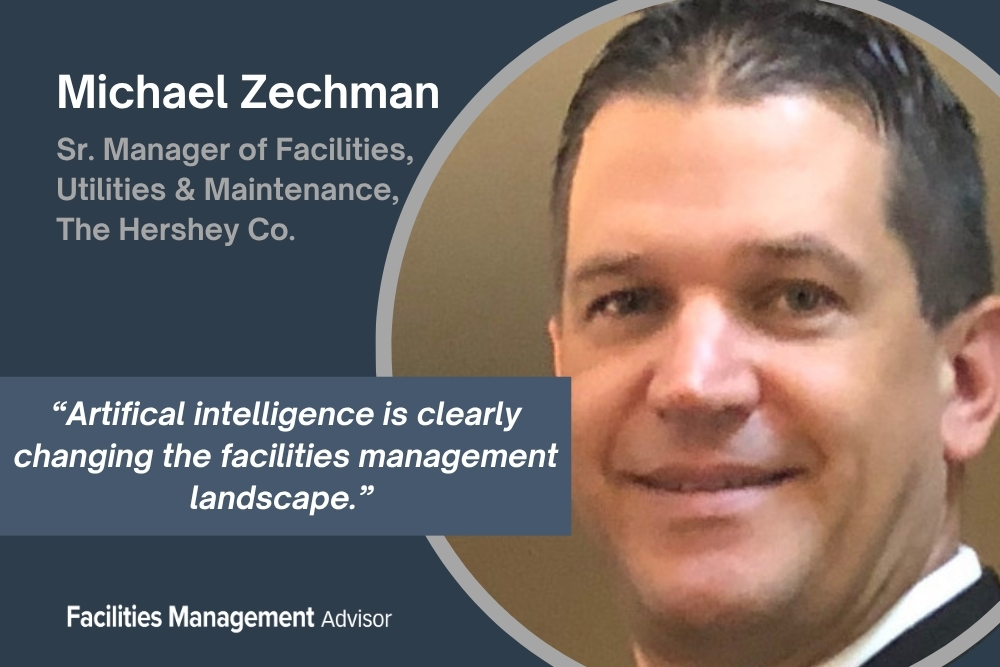
Zechman has spent his entire 24-year-long FM career at Hershey, the Pennsylvania-based confectionery and snacks giant with over 90 brands like Reese’s, Kit Kat, and SkinnyPop. He currently serves as a senior manager of facilities, utilities, and maintenance. In his leadership role, he oversees multiple sites including the corporate headquarters, a warehouse, an innovation center, an R&D facility, and a wastewater treatment plant. His team also supports facility‑related projects across global office locations.
To learn more about Zechman and his take on industry issues, please read the “Faces of Facilities” interview below:
How did you get your start in the field?
I transitioned from a manufacturing background with a strong foundation in electrical systems and controls into facilities management at Hershey. After earning my associate’s degree in electrical technology, I worked in a variety of industrial plant environments prior to joining the company. Once at Hershey, I expanded my expertise beyond the technical aspects of the role and gained broad experience across the facilities discipline, which enabled me to advance throughout my career.
To further strengthen my leadership and business capabilities, I returned to school and earned my bachelor’s degree in operations and project management from Southern New Hampshire University. It has been a meaningful professional journey, and one my younger self could not have envisioned.
Who has been your biggest influence in the industry, and why?
I have benefited from many leaders and mentors throughout my career. The most significant impact came from the engineering leaders who invested time in mentoring me along the way. Mentorship has been critical to my professional growth, providing guidance, visibility, and exposure to challenging and meaningful work streams. Networking has also played an important role in my development. Engaging with facilities management teams from other large organizations and sharing best practices has been an often understated, but highly valuable, benefit.
What’s your best mistake, and what did you learn from it?
One of the most important lessons of my career came from a mistake I initially made—believing that I was not capable of leading people. As a strong introvert, I was most comfortable working independently and never envisioned myself in a leadership role. When I accepted my first promotion into leadership, I did so with the assumption that it would be temporary, as I had no prior experience and did not see myself as a leader. I knew, however, that I had to commit to learning and finding my way.
Once I shifted my mindset and focused on listening to my team—understanding their needs, perspectives, and feedback—I quickly realized that leadership was where I belonged. That experience reshaped how I view growth and opportunity. As Richard Branson said, “If somebody offers you an amazing opportunity but you are not sure you can do it, say yes—then learn how to do it later.” That mindset has stayed with me throughout my leadership journey.
What are some of the biggest facilities management issues at your organization? Are there any unique FM challenges (or benefits) compared to some other organizations?
Resourcing is a consistent challenge, as the volume and complexity of work often outpaces available team capacity. Accurately tracking workload and demand is critical to making a strong, data‑driven case for additional resources.
One of the greatest strengths of the facilities team at Hershey is the depth of experience within the organization. When you build highly capable teams, the business develops trust in your recommendations and decision‑making. In my role, I am confident in the strength, expertise, and performance of my team—they are truly world‑class.
What’s your favorite part about working in the industry?
What I value most about my role is the people and the fact that no two days are ever the same. I am rarely in the same office, workspace, or facility from one day to the next, which brings constant variety and challenge. Over the years, we have encountered situations and requests that often leave us saying, “I’ve never seen that before”—and somehow, that continues to happen. Those experiences keep the work engaging and continually push us to learn and adapt.
Ultimately, it is the people who make the workplace truly special—not only within the facilities team, but across all the departments we partner with. The collaboration and relationships built with such talented teams are what make the work both rewarding and meaningful.
What changes would you like to see in the FM industry?
Through conversations with external facilities management teams, I have observed a recurring gap in understanding the technical aspects of facilities and how they operate behind the scenes. One change I would encourage across the industry is greater focus on learning what happens “behind the walls.”
While leaders do not need to be expert maintenance professionals, having a foundational understanding of the technical work their teams perform goes a long way. This background enables more effective leadership, stronger advocacy for the work being done, and clearer communication when presenting projects to engineering and technical leaders. Ultimately, this level of understanding helps streamline approvals and ensures critical work within facilities is properly supported.
How can company leaders make facilities management a value within their organization?
Leaders understand the importance of the workplace and the experience employees have within their facilities. In large organizations, facilities management can have a significant impact on the bottom line by extending asset life, reducing operational expenses, and increasing employee productivity. Showcasing these outcomes through disciplined expense management, capital planning, and performance‑driven projects allows facilities teams to clearly demonstrate their value with measurable, data‑based results.
A critical component of this success is visibility—proactively engaging with executive‑level leaders and clearly communicating the work being done and the value delivered. Too often, facilities organizations operate in the background, and as long as there are no disruptions, their contributions go unnoticed. This “keep the lights on” mentality can become a liability when issues arise, reinforcing the importance of consistent communication, strategic alignment, and ongoing visibility of facilities’ role in supporting business performance.
Where do you see the industry heading in five years? Are you noticing any major trends?
The rapid advancement of artificial intelligence is clearly changing the facilities management landscape. It is important to approach AI thoughtfully—learning, adapting, and integrating these tools in a practical and responsible way.
Within my organization, we are already leveraging AI‑enabled tools to help manage, plan, move, and maintain our facilities. These capabilities are freeing up valuable time for the team, allowing them to focus on higher‑value work and strategic priorities.
I see this trend continuing and expanding quickly, with AI becoming an increasingly important enabler of efficiency and effectiveness across the facilities management industry.
What are you most proud of?
I am most proud of my team. They are truly the reason I come to work each day and why I am committed to supporting them. They consistently bring forward new ideas, manage a demanding workload with professionalism, and work collaboratively across the organization at Hershey. Their ability to partner cross‑functionally and deliver results makes a meaningful impact every day. I am fortunate to work alongside such an exceptional group, and I am confident in saying that I have the best facilities team in the world (#NotSorry).
Do you have any advice for people entering the profession?
I believe in staying curious and consistently challenging the norm. When I look back on my growth at Hershey, a key factor was my willingness to address issues that had been left untouched for years simply because “that’s the way it’s always been done.” Some of the strongest attributes I see in emerging professionals in this field are their ability to identify and solve problems others may not even realize exist. Challenging the status quo is essential to progress. Equally important is a commitment to continuous learning—leaning into your strengths and taking full advantage of opportunities as they arise.
Anything else you’d like to add?
I believe strongly in being involved in the community—both internally and externally. Along with a group of dedicated team members, I help organize an annual employee golf event that raises funds for an internal assistance program supporting employees impacted by disasters or life‑changing events. What began as a simple idea seven years ago has grown into a meaningful annual tradition that brings employees together, strengthens our corporate culture, and supports those in need. Creating and sustaining initiatives like this is incredibly rewarding, as there is truly no greater gift than giving.
Are you or a colleague an FM professional interested in being profiled for the “Faces of Facilities” series? Please contact Editor Joe Bebon at JBebon@BLR.com.