
Editor’s note: FM Perspectives are industry op-eds. The views expressed are the authors’ and do not necessarily reflect those of Facilities Management Advisor.
With the increasing energy supply volatility today, renewable power is one of the key differentiators for commercial and industrial facilities in managing operational cost fluctuations. Integrating solar or wind power into a building energy strategy can insulate organizations from rising electricity prices and improve operational resilience.
Electricity costs have become a central part of today’s conversation for building owners and facilities managers. In the United States alone, industrial and commercial electricity prices have been steadily rising for the last decade. The average industrial price increased 27.5% between 2016 and 2025, according to the U.S. Energy Information Administration. Commercial prices were up 28.5%.
Prices are expected to continue rising as demand has surged in the U.S. and around the world due to the increasing electrification of the industrial, transportation, and building sectors. Global power demand is expected to grow by 3.6% in 2026, up from 3% growth in 2025, according to the International Energy Agency (IEA).
In some markets, tight supply and growing demand from data centers have contributed to record prices. At the same time, aging distribution and transmission infrastructure is struggling to keep up with consumption and slowing deployment of new electricity generation. Power grids in the U.S. and Europe mostly date back to the last century. The IEA projects that meeting electricity demand in the next five years will require annual grid investment to increase by about 50% by 2030 from today’s $400 billion.
Investments in grid equipment and utility-scale generation are critical for a fully functioning electrical system. But at the same time, they are raising concerns about the affordability of the energy transition. Higher power bills threaten the competitiveness of the manufacturing industry, where energy costs can account for 20% to 35% of the total operating budget.
The Case for Renewables
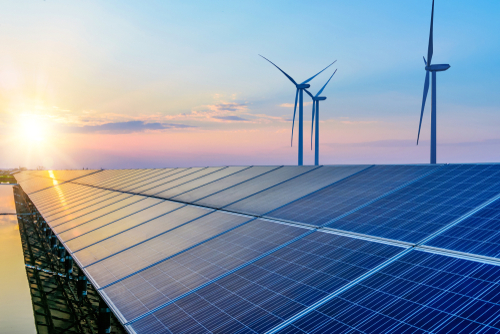
In this environment, on-site renewable power—especially when pairing solar panels with battery energy storage systems—has shifted from a “green” sustainability initiative to one of the most effective risk management tools for building owners and facilities managers. Powering operations in the future requires us to reimagine buildings. They have to shift from passive energy consumers into active energy hubs that independently generate, store, and share power and intelligently manage the power they use to do more with less.
The business case for renewables rests on three clear advantages:
- Predictability: Unlike fossil fuels, the fuel inputs for wind and solar are free. Once the infrastructure is in place, the marginal cost of energy remains near zero. That predictability helps facilities managers plan and hedge energy costs more effectively.
- Stability: Wind and solar aren’t constantly available and predictable. However, the rapid growth of battery storage is helping to solve this long-standing intermittency challenge. For industrial users, battery storage smooths supply fluctuations and helps ensure reliable renewable power for around-the-clock operations.
- Resilience: By decentralizing energy production through microgrids and on-site solar, companies can reduce reliance on fragile grids and distant supply chains. In 2025, for example, solar generation from distributed assets such as rooftop photovoltaics grew 11% in the U.S. from the previous year. In an era of climate and geopolitical uncertainty, generating power closer to the point of consumption strengthens self-sufficiency and operational continuity.
A Call to Action for Property Owners and Facilities Managers
The potential for solar energy in the commercial and industrial sectors is enormous. Despite the visibility of solar panels on major logistics hubs and big-box retail stores, the vast majority of commercial and industrial sites remain underutilized. One study from 2020 found that just 3.5% of commercial buildings in the U.S. had solar panels on their roofs. Europe is further along in its solar adoption but also has untapped potential to generate clean energy: About 10% of European building roofs are equipped with photovoltaics.
Distributed on-site generation adds new electric capacity and does not require the rest of the grid’s customers to pay for it. There’s no buildout of new high-voltage transmission lines, new substation capacity, or new distribution feeders.
Because on-site generation doesn’t require the infrastructure or permitting needed to move large quantities of electricity, assets can come online in months compared to years for utility-scale projects. The shortened timeline is critical at a time when the demand surge that is driving electricity prices higher has already arrived, and the conventional generation needed to meet it can’t be built fast enough.
In a growing number of regions, distributed renewable assets are the grid’s most realistic source of incremental capacity, and the buildings that host them have become the most strategically valuable, energy-generating real estate.
The question is no longer whether you should broaden your energy mix with renewables, but how quickly you will be able build a more stable and sustainable on-site, renewable-generated energy ecosystem.
Giampiero Frisio is president of ABB Electrification, a unit of global technology company ABB.