
When a warehouse hits capacity or a maintenance shop can’t keep up with fleet growth, facilities managers face a decision that shapes the next decade of operations. The traditional path is a stick-built expansion, where general contractors frame and finish a structure on-site from raw materials. The alternative is a prefab metal building, where major structural components are manufactured off-site and assembled on the pad in a fraction of the time.
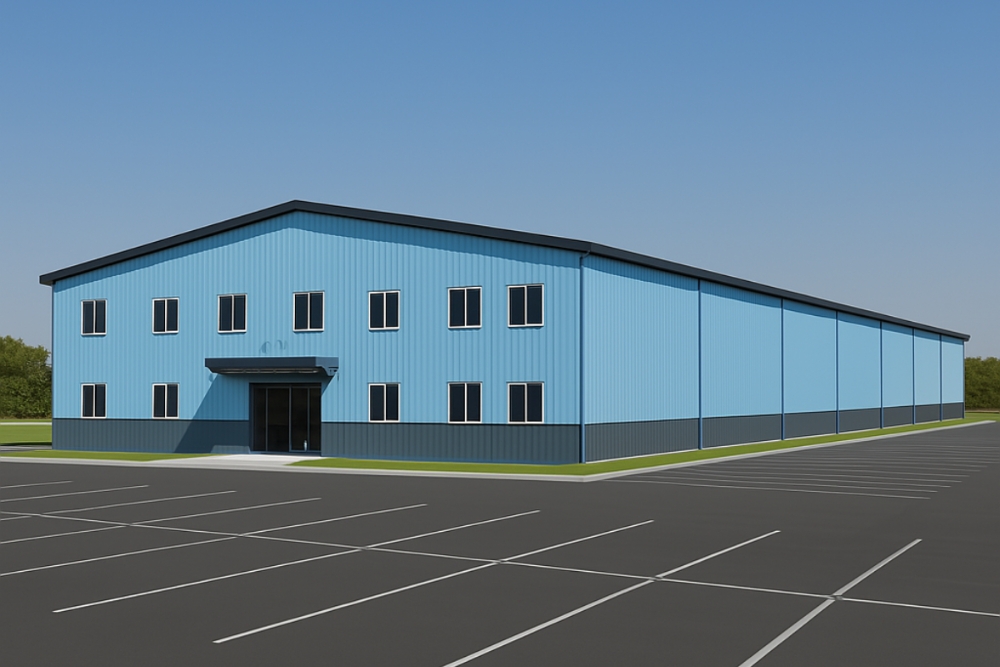
According to industry data compiled by the Steel Buildings Guide, pre-engineered metal buildings account for an estimated 40-50% of all new low-rise nonresidential construction in the United States, and that market share continues to climb. The differences in cost, timeline, and operational disruption between the two methods are significant enough to change the math on most industrial projects.
Comparing Cost Curves for Industrial Expansions
The cost gap between prefab and stick-built depends on the project’s size, location, and complexity. For straightforward industrial structures between 5,000 and 50,000 square feet, prefab metal buildings consistently come in lower on total installed cost per square foot.
Material costs tell only part of the story. According to pricing data from the Construction Owners Association of America, a prefab building kit for a 10,000-square-foot warehouse typically runs $8 to $15 per square foot for labor alone, while pre-engineered steel materials average $15 to $25 per square foot. Equivalent stick-built framing materials often land between $20 and $35 per square foot, with labor adding $15 to $30 per square foot on top of that. The real separation happens on the labor side. Prefab erection crews typically number four to eight workers and complete the shell in three to six weeks. A comparable stick-built project might require significantly more workers across multiple trades over three to six months. Fewer labor hours and a compressed schedule pull total project cost down considerably. The Construction Owners Association estimates that total cost of ownership for prefabricated steel typically comes in 20-40% below comparable traditional structures, and on a 10,000-square-foot building that labor differential alone can represent $40,000 to $80,000 in savings.
The table below shows approximate ranges for a typical 10,000-square-foot industrial building in a mid-cost U.S. market.
| Factor | Prefab Metal Building | Conventional Stick-Built |
| Structural material cost per sq ft | $15 to $25 | $20 to $35 |
| Labor cost per sq ft | $8 to $15 | $15 to $30 |
| On-site construction time | 6 to 12 weeks | 6 to 12 months |
| Total installed cost per sq ft | $25 to $55 | $50 to $100+ |
| Order to occupancy timeline | 10 to 16 weeks | 24 to 52 weeks |
These figures reflect the building envelope and do not include site preparation, foundation work, or interior buildout. Cost ranges are drawn from the Titan Steel Structures 2026 Steel Building Price Guide and the Construction Owners Association of America. Actual costs vary by region, engineering requirements, and local labor rates. Facilities managers evaluating both options should request quotes that break out material, labor, and timeline separately so the two approaches can be compared on equal terms.
Timeline Advantages for Active Facilities
For a facilities manager overseeing active operations, the project timeline matters almost as much as the budget. Every week of on-site construction introduces equipment traffic around the job site, safety coordination requirements for employees and visitors, and potential conflicts with shipping and receiving schedules. In some cases, a lengthy construction project can cost more in lost operational efficiency than the expansion saves in material expenses.
Prefab metal buildings offer a parallel-path advantage that compresses overall project timelines significantly. While the site crew handles grading and foundation work, the manufacturer fabricates the building components at a separate production facility. By the time the concrete pad is ready, the steel package arrives on a flatbed and erection begins immediately. According to an analysis by the Construction Owners Association, this overlap can compress the total project timeline by 40-60% compared to a fully sequential stick-built approach.
A typical 10,000-square-foot prefab industrial building moves from purchase order to occupancy in 10 to 16 weeks, with industry sources reporting six to 12 weeks for construction alone once the foundation is complete. The same structure built conventionally often takes six to 12 months from groundbreaking. That compressed schedule means earlier revenue from the new space, less disruption to current operations, and lower carrying costs during the construction phase. The difference becomes even more pronounced on larger projects, where stick-built timelines can stretch past a year. Operations facing seasonal demand surges, regulatory compliance deadlines, or rapid capacity needs consistently find that the timeline advantage alone justifies choosing prefab.
A Decision Framework for Facilities Managers
Permitting is one of the first practical differences facilities managers encounter when comparing the two approaches. Prefab metal buildings are engineered to meet International Building Code standards and can be designed for specific wind, snow, and seismic load requirements. Most manufacturers deliver stamped engineering drawings with the building package, which can accelerate plan review at the local building department. As Steel Buildings Guide notes, this pre-engineering also reduces material waste by up to 30% compared to conventional framing. Stick-built projects typically require separate structural calculations from a local engineer of record, adding both time and cost before construction begins.
Beyond permitting, the project’s physical requirements usually make the decision clear. Prefab metal buildings perform best when the expansion calls for a large, open floor plan with minimal interior obstructions. Warehouse storage, fleet maintenance shops, equipment staging areas, and covered loading zones all benefit from clear-span interiors that eliminate columns from the usable footprint. A 60- or 80-foot clear span is standard for most prefab manufacturers, while achieving the same open width with conventional framing requires significantly heavier and more expensive structural members.
Stick-built construction still makes sense for multi-story structures with complex architectural requirements, irregular footprints, or extensive built-in mechanical systems. Many facilities managers find that a hybrid approach delivers the best value, using a prefab metal shell for the structure and envelope while conventional interior buildout handles offices, restrooms, or specialized work areas inside the clear-span space. The decision comes down to four factors: the required square footage, the timeline pressure, the budget ceiling, and how much interior customization the finished space demands. Mapping those four variables against the cost and timeline data above will point most facility teams toward a clear answer.
Logan Hermer is director of web development at Metal America, an American-made metal building company headquartered in Austin, Texas.