
2025 was filled with both challenges and opportunities, but like everyone else in facilities management, Matthew Rodriguez is pondering what’s next for the industry in 2026. As a passionate leader and corporate facilities supervisor for KFC US, he’s optimistic that the new year will offer FMs even more chances for business integration, workforce development, and personal growth.
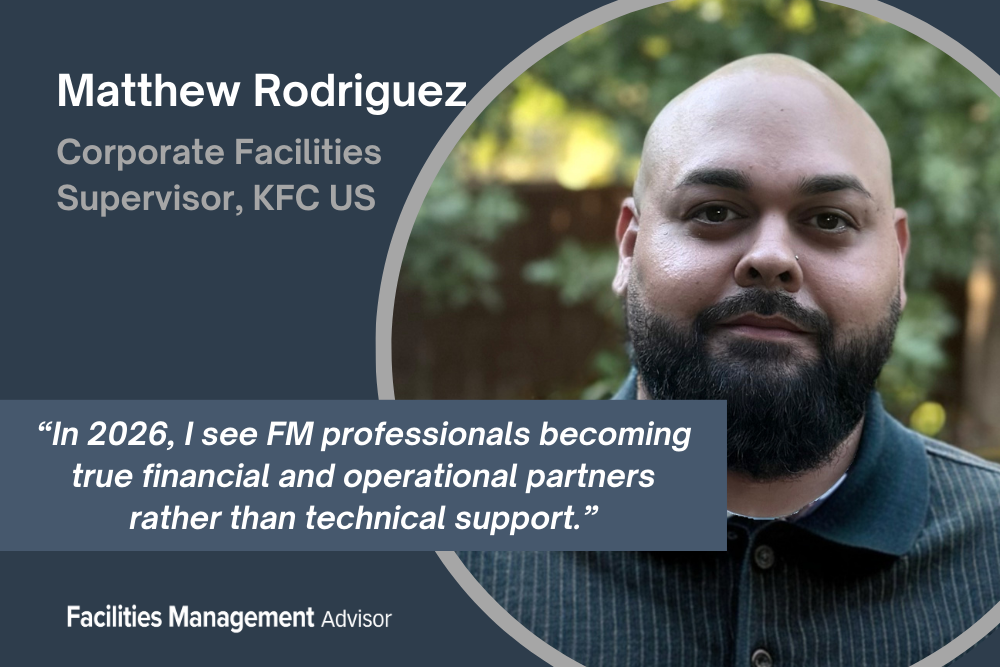
KFC US, part of Yum! Brands, is one of the largest quick-service restaurant organizations in the world. In his role, Rodriguez oversees facilities operations for 34 restaurant locations across Texas, managing maintenance projects, vendor partnerships, and capital planning to keep each site running safely and efficiently.
Rodriguez has been in the industry for a little over a decade. Before joining KFC a year ago, previous job titles included chief engineer for Coury Hospitality’s Southlake Hotel and various FM roles in the fitness world, working across brands like Planet Fitness, 24 Hour Fitness, and Life Time. He holds several certifications, including EPA Universal, HVAC/R, CPO, and Lean Six Sigma Black Belt. He is also a proud member of the Restaurant Facility Management Association (RFMA).
To learn more about Rodriguez and his take on industry issues, please read the “Faces of Facilities” interview below:
How did you get your start in the field?
Phil Ko was one of the first people to invest in me. Around that time, I had developed degenerative bone disease in both hands, and wrenching was becoming extremely difficult. Phil showed me the responsibilities of a facilities manager and the business side of CMMS, and he helped me see a career path beyond the wrench.
I got my start in the fitness industry working on fitness equipment, which expanded into the mechanical side of pools and eventually HVAC systems. I wanted to learn at a pace that allowed the knowledge to stick, and I loved having opportunities to lead and teach. I remember applying for a building engineer position and being told my resume did not hold weight without certifications. Instead of giving up, I worked full-time and attended HVAC/R school at night to earn them. That experience taught me resilience and the importance of continuous learning, and it still guides how I lead and mentor others today.
Who has been your biggest influence in the industry, and why?
It’s hard to name just one person because I’ve been shaped by many. My father, Felipe Rodriguez, and my uncle, Barry Morris, were the first to teach me the value of hard work. I was their tool fetcher growing up, and they made sure I learned how things worked at a young age.
Luke Yant at 24 Hour Fitness helped me understand the foundations of building systems. Phil Ko showed me that there is a career beyond the wrench and introduced me to the strategic side of facilities management. Jose Buentello expanded my understanding of hospitality operations, HVAC systems, and what leadership looks like as a manager, and he still shares his knowledge with me today.
Today, I am fortunate to work under (former “Faces of Facilities” participant) Tee McCluster, who has pushed me to take pride in my experience and lead with confidence and purpose. Tee and Frank have both pushed and helped me learn how to speak with conviction in any room. Last, my brother, Felipe Rodriguez III, continues to inspire me through his work ethic and dedication, reminding me that anything is possible when you stay committed to your craft.
What’s your best mistake, and what did you learn from it?
My best mistake was thinking I had to know everything myself. Early in my career, I took pride in being the one who could fix or manage anything, but that mindset limited my growth and the growth of the people around me.
I learned that leadership is not about having all the answers. It is about building people up so they can succeed alongside you. That realization completely changed my approach to leading teams and building trust.
What are some of the biggest facilities management issues at your organization?
One of our biggest challenges is balancing the immediate needs of a large restaurant portfolio with the long-term planning required to keep our assets reliable. With aging equipment, fast-paced operations, and a high volume of daily demands, staying ahead of issues before they impact our teams or guests takes constant coordination and communication.
As a new facilities department, another challenge has been building the structure, standards, and processes that support consistent operations across multiple markets. At the same time, this has also been one of our biggest advantages. Starting fresh has allowed us to create clear workflows, strengthen our vendor partnerships, and align more closely with operations on both short-term repairs and long-term asset strategies.
The benefit is that our team works extremely well together. We support each other across invoicing, CapEx planning, project coordination, and field guidance, which allows us to respond quickly and still keep our focus on forecasting, budgeting, and long-term reliability. Being able to partner closely with operations and leadership has helped us drive more consistency and support better decision-making across the portfolio.
What’s your favorite part about working in the industry?
No two days are ever the same. One moment you are solving a mechanical issue, the next you are planning a capital project or helping a team member grow. Facilities keeps you on your toes, and that is what makes it so rewarding.
I also love the collaboration. Facilities touches every department, including operations, vendors, engineers, and frontline teams, all working toward the same goal of keeping things running safely and efficiently. There is real pride in walking into a building and knowing you helped make it better.
What changes would you like to see in the FM industry?
I would like to see more organizations invest in the people they already have. There is often untapped potential within current teams, and training, mentorship, and clear growth opportunities can make a major difference. When companies develop their own talent, they strengthen performance, build loyalty, and create long-term success.
How can company leaders make facilities management a value within their organization?
Facilities management should be recognized as a strategic partner, not just a support function. FM influences safety, efficiency, and the guest experience, all of which directly shape brand reputation and performance. When leaders involve facilities early in planning and decision-making and invest in developing their teams, they unlock cost savings, innovation, and stronger operations across the organization.
What are you most proud of?
I am proud of how far I have come, not just in my career but as a husband to Jessica and a father to Matthew II. I remember coming home after finishing HVAC school feeling both accomplished and exhausted. My classes were at night, so it was around 11 p.m. when I walked through the door. My wife was waiting with the biggest smile, a cake, and a card, and that moment hit me.
We didn’t have much, but we had each other, and my only goal was to create a better path for my family. That night felt like the start of a real change in our lives. There were times I was overlooked or told I did not have what it took, but moments like that reminded me why I kept pushing. Every challenge helped shape who I am today.
My family keeps me grounded and reminds me why I do this work—to lead with heart, to build something meaningful, and to make them proud, which is why I take such pride in mentoring and leading those who don’t yet see how far their path in facilities can go.
Do you have any advice for people entering the profession?
Take the “no’s” just as seriously as the opportunities. Every rejection or challenge can teach you something if you let it. I have been told no plenty of times, but each one pushed me to learn more and work harder. This field rewards curiosity, persistence, and humility. Ask questions, stay hands-on, and never stop learning, because every no brings you closer to your yes.
Finally, what do you think is ahead for the FM industry in 2026?
In 2026, I see FM professionals becoming true financial and operational partners rather than technical support. We need to be recognized as the facilities subject matter experts (SMEs) and work directly with the teams that manage the money because we understand asset age, lifecycle costs, and the real impact of repair versus replacement.
There is also a major opportunity to mentor and develop in-house specialists and field teams so they understand how proper maintenance protects equipment and extends its life. When we give them the knowledge and tools to become SMEs in the field, we improve forecasting, strengthen budgeting, and build long-term reliability.
Organizations that treat FM as a strategic partner will stay ahead, and after attending industry events in 2025, I am already seeing that shift begin.
I have been preparing myself for this direction by completing my Lean Six Sigma Black Belt coursework and continuing to strengthen my financial decision-making skills. Throughout my career, I have learned from experienced leaders who helped me refine how I evaluate pricing, understand asset value, and support smarter planning. Their insight added to the foundation I’ve built, and it has positioned me to adapt quickly as the industry evolves.
Are you or a colleague an FM professional interested in being profiled for the “Faces of Facilities” series? Please contact Editor Joe Bebon at JBebon@BLR.com.