
Hotel guest rooms are unoccupied around 60% of the time, even when rented. Heating or cooling to 100% occupancy, 100% of the time, equals approximately 40% energy waste. To lessen this waste, the hospitality industry is embracing occupancy-sensing smart thermostats, which allow the building management system to automatically adjust the temperature of unoccupied rooms.
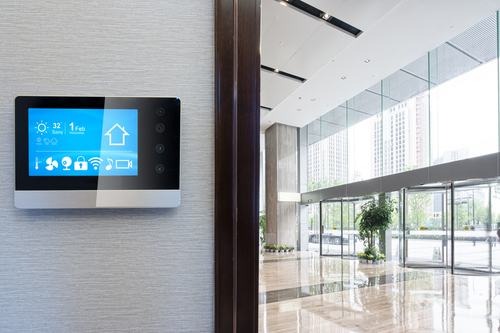
The next evolution of this technology is demand response (DR), which uses occupancy sensing to work with utility providers to lower hotels’ energy waste during peak events. By using scheduled pre-heating or pre-cooling, smart thermostats can curtail energy waste without impacting the guest experience. Paired with a smart thermostat management system, demand response programs can be a net positive for guests, hotel facilities, and the energy providers who support them.
What Is Demand Response?
Demand response is a voluntary reduction in power use to ease strain on the grid during times of high demand. The utility will alert enrolled customers to DR events and compensates customers who participate in energy-saving behaviors during peak hours.
Heavy power demand peaks can overdraw the grid, leading to brownouts—voltage reductions of 10-25%, which can cause electronics to perform poorly, overheat, or fail—or complete blackouts. It’s inconvenient for everyone, but can be catastrophic for hospitals, emergency services, and those dependent on home electronic medical equipment like infusion pumps. Though less dire, in the hotel industry, a brownout or blackout can present risks to guest comfort and safety, as not all properties have backup generators to power more than basic emergency equipment, like exit signs.
Opt-in demand response programs allow utilities to alert participants of a peak demand event so customers can voluntarily reduce energy use, lowering the risks of unexpected outages or brownouts. For hotels, which already use technology to curb energy waste, enrolling in a demand response program is a natural next step.
The Benefits of Demand Response in Hospitality
Demand response for hotels can benefit utilities, the hotel, and guests, if done correctly.
The participation of large fluctuating-occupancy facilities like hotels in demand response programs is ideal for utility providers. Hotels have dozens or even a hundred rooms that are often half-empty. This can have a significantly greater demand response impact than a single-occupancy dwelling opting into the program.
Demand response also makes excellent business sense for the hotel and can contribute to a positive guest experience—when paired with the right technology. Because demand response is opt-in, the hotel can choose how much or little it will participate. Most hotels are conservative with temperature management practices, choosing to maximize guest comfort and control rather than risk a negative guest experience.
Smart thermostats have a proven reputation for balancing power conservation and guest comfort. Simple occupancy-sensing technology adjusts an unoccupied room’s temperature to a preset degree, determined by the hotel’s management platform. Door and window sensors can add further energy-saving technology to a room, pausing heat or AC if an external door or window is left ajar and ensuring the heat or AC isn’t left on for an entire day while occupants are out of the room, enjoying their vacation. Many modern smart thermostats easily integrate with existing building management systems, lowering the barrier to entry for hotels to engage in demand response programs and making it easier to save on energy use.
Newer smart thermostat equipment helps hotels be more aggressive with demand response without sacrificing guest comfort. Advanced features like pre-cooling and heating, zoning, and simpler front desk control enable this. Using pre-cooling and pre-heating functionality, smart thermostats can lower or raise the room temperature in preparation for a demand response event to keep temperature shifts stable during peak shutdowns.
With the right technology, hotels can program smart thermostats to create a highly customized set of rules for temperature control by dividing the rooms into zones—e.g., one zone could be based solely on the amount of sun exposure. Today, many smart thermostats have more user-friendly controls to improve the guest experience. For example, if a guest is unhappy with their room temperature experience, the front desk can remove that room from the automation for a set amount of time, such as when the guest will check out. Or, if the front desk is getting complaints from multiple rooms in that zone, it could turn that entire zone off from automation for a set amount of time. The guest then gets complete temperature control of their room for a set amount of time, the front desk staff can make the change without having to call maintenance, and the regular temperature preset program can run again after the “VIP” mode period expires. The thermostat technology—and the technology that supports it—is getting smarter.
Integrating Demand Response Technologies into a Smart Thermostat Ecosystem
Hotels looking to engage in demand response need at least three things:
- A building management system;
- Smart thermostats; and
- A utility company with a demand response program.
Once all guest rooms are outfitted with occupancy-sensing smart thermostats, managed by a platform integrated with the building management system, the hotel can enroll in a demand response program. An API (application programming interface) can connect the thermostat management system to the demand response alerts from your utility.
Each hotel property must decide on its presets to ensure optimal guest comfort while maximizing demand response savings. There are some universal best practices to consider, including time of year and local weather, as well as many choices each property must make.
Hypothetical Hotel: Demand Response Example Case
Consider Hypothetical Hotel, a fictional, hundred-room hotel, equipped with the latest smart thermostat technology, that is enrolled in a demand response program with its utility provider. The hotel building sits on a lot with some trees, but the west side of the hotel gets full afternoon sun exposure.
The building managers used the smart thermostat system’s management software to program its occupied, unoccupied, and demand response event presets. They chose a summer preset cool temperature of 72°F for occupied rooms and 77°F for unoccupied rooms. The smart thermostat system they selected includes zoning capabilities, which allowed hotel management to create a dedicated zone for the west-facing rooms.
When the building management system receives a demand response alert from the utility, the smart thermostat system’s demand response preset program begins to run. Unoccupied rooms are not pre-cooled at all; they remain at their preset, unoccupied temperature of 77°F. In the occupied rooms, the smart thermostats turn the AC on, cooling to a few degrees below the ideal temperature. During the demand response event, the AC will turn off entirely, allowing the residual pre-cooling to maintain the room near its ideal 72°F.
The temperature will very gently rise to 72°F or perhaps slightly past it in the time it takes for the demand response event to end. Because the west side of the hotel gets full afternoon sun, if the DR event occurs during afternoon hours, the smart thermostat management system has been programmed to omit that zone from running its demand response program. And if a guest complains to the front desk that their room is too warm, staff can simply override the automation for that single room for 48 hours to ensure complete guest comfort and control.
Multiply this by Hypothetical Hotel’s 68 occupied rooms (out of 100), and both the utility company and the hotel have saved an estimated kilowatt-hour or more per room per hour during the demand response event. And the hotel room occupant may not have even noticed.
Demand Response Works—with the Right Tech
We haven’t yet reached a point of mandatory demand response participation. But with the rise of AI, the boom of data centers, and their accompanying staggering draw on the power grid, that time may be coming. Large properties with fluctuating occupancy like hotels are strong candidates for demand response programs. But because hotels are first and foremost in the hospitality industry, the guest experience is the priority. Smart thermostats have come a long way, bridging the gap between hotel energy savings and guest comfort. The newest generation of smart thermostat management systems may be the key to bridging this next gap to strong demand response capabilities.
Andrew Cao is director of technology and product portfolio at Copeland, a global provider of sustainable climate solutions.
ALSO WATCH: Joe on the Go: Hotel Marcel, the Greenest Hotel in America