
By now, facilities managers may have seen the headlines: Self-cleaning restrooms are making their mark across cities, promising to automate maintenance, reduce labor demands, and easily sanitize high-traffic public spaces. Public restrooms can be demanding spaces to manage, and the costs of getting them wrong are real and measurable. Any technology that raises the baseline, frees up staff time, or improves operational efficiency deserves serious consideration.
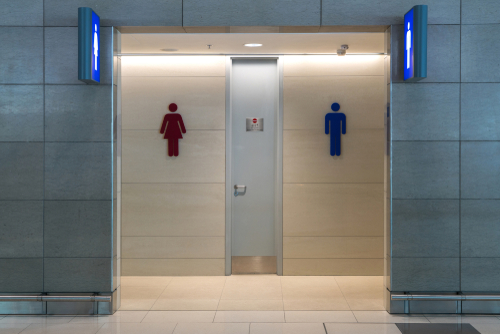
But technology is only part of the story. Automation alone doesn’t guarantee a great restroom experience, and a skilled cleaning team working without the right data and tools will face its own limitations. The facilities consistently delivering on hygiene are tapping into both cleaning staff experience and the latest technology, deliberately and in tandem. Here are three concrete ways to make that collaboration work.
1. Define the Division of Labor Before You Deploy
Getting the most out of restroom technology starts with a clear picture of what it will handle and where human expertise picks up from there.
Automated cleaning has tangible, valuable functions. A self-cleaning cycle can rinse surfaces. A connected dispenser can track supply levels. Occupancy sensors can flag high-traffic periods. But none of them accounts for the moment supplies run out faster than the algorithm predicted, or when a guest encounters a public restroom that is technically functional but far from welcoming.
Before deploying new technology, facilities managers should map out precisely what each system will and won’t manage: which functions will be automated, which will still require human judgment, and what a fully completed service round looks like in the new model. That role clarity is what prevents the operational gaps that erode employee and guest trust in both the technology and the public restroom experience itself.
2. Empower Your Cleaning Team with Data, Not Just a Schedule
One of the most underutilized benefits of hygiene technology is its ability to sharpen how cleaning professionals do their jobs.
Traditional fixed cleaning schedules assume a public restroom’s needs are predictable. But anyone managing a high-traffic facility knows that usage spikes, special events, and unexpected incidents can render a predetermined cleaning routine obsolete within hours. When staff work from a static plan rather than real-time information, they may spend time in low-traffic areas while a busy area of the building is running low on supplies or needs immediate attention.
Connected tools, like usage-based dispenser monitoring, traffic analytics, and real-time service alerts, give cleaning teams the visibility to prioritize where they are needed most. It does this by providing real-time data on hygiene conditions across the facility to the right people who are trained to act on it.
Technology can also help address a very real workforce challenge. Research shows that 80% of cleaning staff report mental health issues as a result of their jobs, with 46% specifically citing stress and 70% citing inadequate employer support. When facilities managers use data-driven cleaning technology to reduce unnecessary processes, minimize product waste, and give staff clearer priorities, they are investing in the people whose expertise makes quality hygiene possible, while improving operational efficiency across the board.
3. Monitor Hygiene from the Guest’s Perspective
While data-driven cleaning gives facilities managers visibility into task completion, guest experience is often where public restroom performance is won or lost.
The stakes are significant. Research shows that only 1 in 5 public restrooms currently meet hygiene and cleanliness expectations, and 52% of people take action after a poor public restroom experience—such as spending less time at a venue, limiting food and drink purchases, or leaving a negative online review. In workplace settings specifically, 1 in 4 employees report spending less time at the office due to poor workplace restrooms, and 15% say they have worked from home more than they otherwise would have.
An automated cleaning system can log a restroom as “serviced” while a guest still encounters paper hand towel clutter, an unpleasant odor, or a mysterious stickiness on the floor. Feedback loops that capture the full user experience are essential for ensuring what the data reflects the hygiene quality of the restroom.
That guest-focused lens also needs to account for the full range of people using those spaces. Research shows that 54% of venue visitors contend with a physical or cognitive challenge that can affect their public restroom experience, from skin sensitivities and limited mobility to anxiety and sensory sensitivities. Addressing those barriers can be as simple as selecting gentler soap formulas for guests with skin sensitivities or implementing touch-free dispensers for guests with mobility concerns. Technology can help staff see more of what is happening in a facility, but cleaning professionals are the ones who can observe, adapt, and respond to conditions in real time.
The Future Belongs to Facilities That Master Both
The rise of self-cleaning restroom technology reflects something meaningful: Hygiene is earning its place as a strategic priority alongside the other core investments that define a well-run facility. For facilities managers, that shift creates a real opportunity to rethink how public restroom performance is measured, resourced, and delivered.
The facilities that set the standard will be those that pair automation’s efficiency with the adaptability, judgment, and responsiveness that only skilled cleaning professionals provide. Together, those two forces make for a more resilient, higher-performing operation. And in an industry where guest expectations keep rising, this is how facilities can stay ahead of them.
Christine FitzPatrick is a regional activation manager at Tork, an Essity brand.