
Editor’s note: FM Perspectives are industry op-eds. The views expressed are the authors’ and do not necessarily reflect those of Facilities Management Advisor.
The morning looks like any other: elevators moving, tenants badging in, the lobby filling with familiar faces. Then—gunfire erupts in the lobby. Security scrambles for their radio. By the time 911 confirms, chaos has spread throughout the building, and the situation is on the move.
Gun violence doesn’t announce itself. It strikes anywhere and when you least expect it. FBI data confirms that 43% of active shooter incidents hit places of business, 74% in publicly accessible spots, and 46% outdoors or in open areas like entrances that are often beyond your security perimeter.
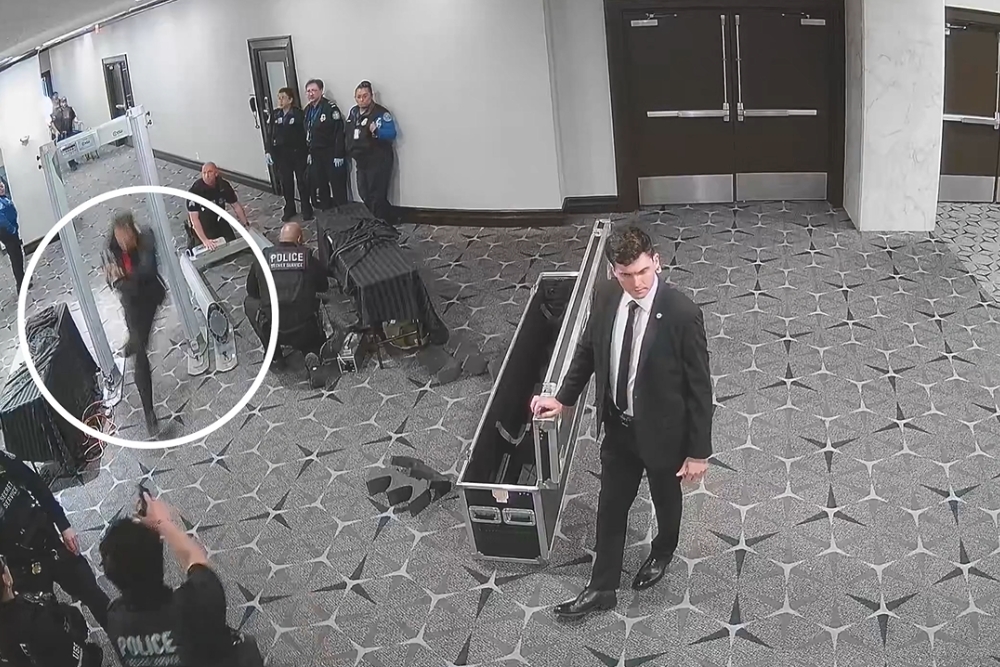
Two recent incidents—a shooting in a Manhattan office lobby and an armed intrusion at the White House Correspondents’ Dinner—illustrate what happens in the shared spaces between security layers, and why facility administrators bear direct responsibility for what those spaces are equipped to do.
Why Early Response Often Fails in Shared Interior Spaces
Many active shooter incidents conclude within minutes, often before law enforcement arrives. During that window, facility staff and occupants must make rapid decisions based on incomplete or conflicting information. In buildings with open lobbies, interior corridors, and shared entry points, early uncertainty can delay coordinated response.
In the Manhattan office building incident, gunfire began in a public lobby directly connected to secured tenant spaces. While the building had cameras, access control, and on-site security personnel, the initial response depended on human recognition and manual activation of emergency procedures. The security guard had access to a panic button capable of initiating elevator lockdown, but was fatally wounded before that action could occur. Vertical access remained available, demonstrating how response models that rely on human intervention can break down under immediate threat.
The White House Correspondents’ Dinner incident revealed a different but related gap. Video released after the incident shows the suspect moving into a room off a public hallway, briefly drawing the attention of a K9 unit before being assessed as non-threatening. In the same frame, officers can be seen dismantling magnetometer screening equipment—reflecting an assumption that active screening had concluded. Moments later, the suspect re-enters the corridor and runs directly through one of the magnetometers toward the event space. The sequence illustrates how quickly conditions can change in areas between security layers, and how reliance on human assessment and procedural timing can leave short but consequential gaps.
A Limitation Built Into Preventative Security
Both incidents share a characteristic that facilities administrators rarely discuss—the assailants were not deterred by the security measures in place and, in at least one case, appear to have planned around them.
Most preventative security technologies function on an implicit assumption that the person encountering them has some reason to comply. A visitor passing through a weapons screening checkpoint has a legitimate purpose for being in the building and participates accordingly. Access control works because authorized users badge in and unauthorized users are stopped at the door. These systems are effective precisely because most people, most of the time, have no intention of circumventing them.
A person who has decided to commit an act of violence operates under an entirely different set of conditions. The Manhattan incident illustrates this directly—the assailant demonstrated no concern for existing security protocols or preventative safeguards. Reporting on the White House Correspondents’ Dinner incident reflects a comparable mindset: someone who had already made a decision that rendered deterrence largely irrelevant. Individuals who plan these acts often do not expect to leave. That calculus changes everything about how they interact with security infrastructure.
Screening, uniformed presence, and layered access controls remain important components of a security program. But they are most effective against threats that have not already committed to action. Understanding this distinction is not an argument against preventative security—it is an argument for ensuring that detection and response capabilities exist independently of whether a threat was stopped at the perimeter.
Gunshot detection does not operate on the assumption of compliance. It responds to a physical event—the discharge of a firearm—regardless of the intent, preparation, or prior behavior of the person who fired it. That distinction matters when designing security programs for environments where the people most at risk are also the most accessible.
From Detection to Coordinated Action
Response activities begin only after an incident is confirmed with sufficient confidence. In many facilities, that confirmation still depends on staff observation, bystander reports, or 911 calls, with each step introducing delay and interpretation.
Automated gunshot detection systems reduce this delay by verifying gunfire using physical signals emitted at discharge and reporting the event within seconds, with location data, and without requiring human validation. When integrated with existing security infrastructure, verified detection can direct cameras to the incident location, restrict access to adjacent areas, and deliver targeted alerts to staff and responders, all based on confirmed data rather than assumption.
Consider a large office building during peak occupancy where a single gunshot occurs in a public interior area. An automated system verifies the event within seconds, identifies its location, and alerts the facility operations center while integrated cameras provide immediate visual context. Security teams, staff, occupants, and responders receive accurate, location-specific information early, enabling coordinated action.
These capabilities extend across facility types. Office buildings, hospitals, hotels, and campuses share the same structural characteristics: open circulation, mixed-use spaces, and reliance on staff to interpret events in real time. Automated detection introduces a consistent method for identifying gunfire and initiating response without increasing mental load during a crisis.
Operational Readiness and Administrative Accountability
Facility administrators hold responsibility for occupant safety, tenant protection, and operational continuity. After an incident, the questions are predictable: Was there a system in place to detect the threat? How quickly did the response begin? What does the record show?
Gunshot detection systems generate documented records of detection time, location, and system response—supporting after-action review, coordination with authorities, and internal accountability. This documentation matters. It demonstrates that reasonable, proactive measures were in place to provide immediate awareness and support life-safety decisions during the earliest moments of an incident—before human judgment had time to catch up.
A layered security approach functions effectively when layers communicate together. Screening stops the compliant. Detection addresses the committed. Automated gunshot detection strengthens this structure by ensuring that response mechanisms already in place can engage based on verified information rather than assumption or delay—independent of whether a threat was deterred at the perimeter.
In environments where the people most at risk are also the most accessible, the margin between early awareness and delayed response is not a technical detail—it is an administrative decision. The technology to change that outcome exists today. For facility administrators, the question is no longer whether gunshot detection belongs in a security program—it is whether your program is complete without it.
James Reno is vice president of commercial business at Alarm.com, where he leads commercial strategy and market expansion across North America for both Alarm.com and Shooter Detection Systems (SDS). Reno brings more than 25 years of leadership experience across physical security, identity management, and critical infrastructure security in both the public and private sectors.
ALSO WATCH: FMA Shorts: What Should You Do During an Active Shooting?