
U.S. companies are increasing expectations for employees to work from the office, with 89% of respondents in CBRE’s 2026 Office Occupier Sentiment Survey requiring at least three in-office days per week, up from 78% a year earlier. Despite the focus on office attendance, only 14% of companies are making major improvements to their space, suggesting they are not investing to make their workplace a place employees want to be.

The survey highlights a gap between priority and action among office-using companies. While 62% of respondents cite enhancing employee experience as a priority, nearly half (47%) of the 97 companies surveyed rate their workplace experience as average or below average compared with peers.
“The market has shifted from whether the office matters to whether it delivers,” said John Morris, CBRE’s group president of advisory leasing in the Americas. “Companies are asking employees to spend more time on-site, but without the right investment in the office experience, the office risks falling short as a competitive advantage. Sometimes, even smaller experiential improvements can pay dividends, like creating dedicated space for different food vendors in the lobby, free coffee, white noise in open areas, and more phone booths.”
Beyond workplace investment, the report also highlights how artificial intelligence (AI) is beginning to influence occupier decisions. Nearly a quarter (23%) of organizations already see AI affecting space planning today, while another 30% expect it to have an impact within the next two years.
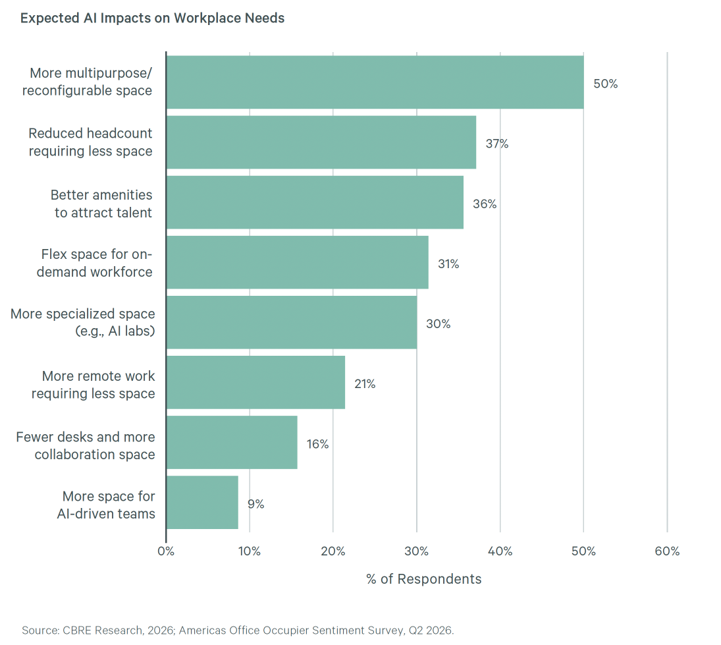
Among the most common expected changes are more use of flexible, reconfigurable space (50%), increased need for higher-quality amenities (36%), and demand for specialized environments such as AI labs and innovation spaces (30%).
In addition, 37% of respondents anticipate some headcount reduction due to AI. However, only 4% of those respondents are planning significant space reductions in the next three years, suggesting AI is mostly driving broader changes in how office space is used.
“AI is a catalyst for office redesign,” said Julie Whelan, head of occupier research at CBRE. “Occupiers are rethinking how space supports collaboration, innovation, and specialized work, which will continue to drive demand for higher-quality, more adaptable workplaces.”
Looking at the broader market, survey results point to a more stable office market. Two-thirds of organizations plan to maintain or expand their portfolios over the next three years, consistent with last year’s CBRE survey.
Larger companies, which were more active than their smaller counterparts in shrinking their office portfolios in recent years, now are moderating those efforts. Among organizations with 10,000 or more employees, the share planning to reduce space has declined to 46% from 60% a year earlier.
Across all sizes of companies, 38% of organizations expect their footprint to grow over the next three years, compared with 34% that anticipate contraction. This could translate to gains in net absorption, particularly in central business districts in key office markets.
This emerging growth is being driven in part by industry-specific demand, with the technology sector poised to lead expansion. Nearly two-thirds (64%) of tech companies plan to grow their footprint, up significantly year-over-year and larger than any other industry in CBRE’s survey.
Leasing activity further underscores which industries are driving demand. In the first half of the year, tech firms led U.S. office-leasing activity with a 21% share, while financial services represented about 16%. Tech has rebounded since its recent low of 13% in 2023.
The full report is available here.