
In a single office, workplace design often reflects a company’s identity, but within a multi-office portfolio, it begins to define it. As organizations grow, it’s less about how individual offices perform and more about how they work together as a whole to establish a cohesive and consistent culture. Without a structured approach, each office starts to take shape differently, which can lead to inconsistencies in layout, experience, and overall organizational performance. A scalable design strategy closes that gap by translating the company ethos into a unified approach that is recognizable in all offices, no matter its location.
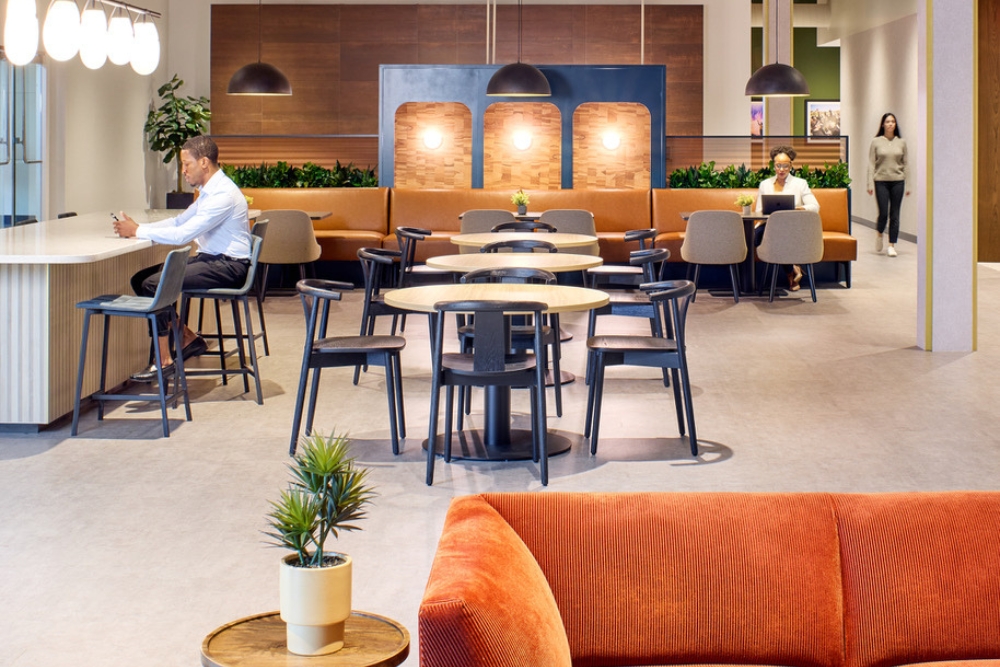
When designing multiple office locations, the answer isn’t replication; it’s a tailored system that can physically adapt to the nuances of each location. Through this design strategy, organizations can scale a distinct workplace experience in offices nationwide, even worldwide, without turning each space into a rigid duplicate of one another. Below are the three ways offices can scale culture across offices:
1. Build A Sense of Ownership
In making employees feel genuinely connected to where they work, the answer usually lies in the details of the materials, the atmosphere, and the way a space reflects the city outside its windows. When these elements are built into the spatial concept from the beginning, the office stops being somewhere employees show up to and becomes somewhere they belong. That sense of belonging is deepened when employees recognize themselves in the space, which is why the design process benefits from direct input from the people who will use it. Engaging employees early, whether through surveys, workshops, or site-specific research, surfaces the local knowledge that no external team could arrive with: the neighborhood references that resonate, the cultural touchstones that carry meaning, the small details that signal the company genuinely knows where it has landed. The city acts as the starting point, with the design process drawing from:
- Local History and Architecture: A study of the city’s built environment and defining moments that reveal what makes each place genuinely distinct.
- Climate and Geographical Landscape: The colors, textures, and environmental qualities that define a region, translated into the material and atmospheric tone of the space.
- Cultural Identity and Community: The less tangible markers of a city’s personality, including its pace, its pride, the things its residents would immediately recognize.
When employees recognize their city in the space around them, the office earns a different kind of significance: one rooted in pride, and in the daily reminder that their work is inseparable from the communities they serve.
2. Cultivate an Environment of Hospitality
There’s a difference between a workplace that functions and one that genuinely receives people. The latter is the result of hospitality as a design commitment, which is made present in the arrival experience, communal spaces, and every touchpoint in between. When that commitment holds across every location, it transforms a well-planned office into one people are excited to return to. This means establishing a consistent set of destinations and experiential anchors that show up in every office with the same level of care, regardless of market, with hospitality as the common thread that holds that standard across the portfolio.
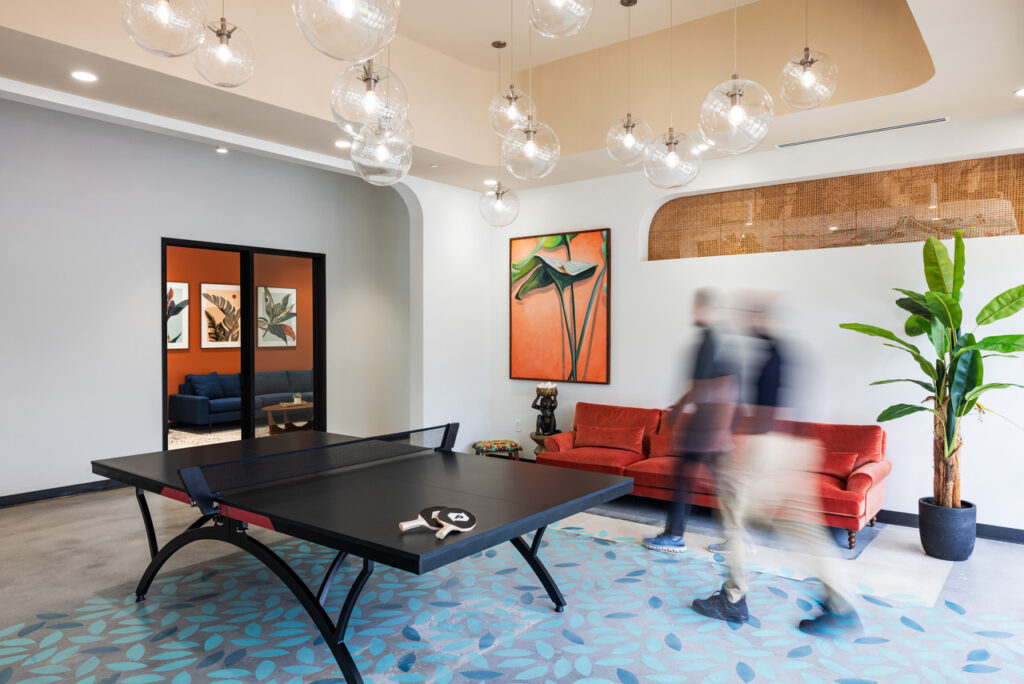
Key elements include:
- A Welcoming Arrival Sequence: Reception areas with custom millwork, award displays, and brand presence that set the tone from the moment someone enters.
- Social and Gathering Anchors: Cafés, lounges, and game areas positioned consistently to support culture and connection.
- Training and Collaboration Environments: Sized and equipped to reflect how the organization actually develops its people.
- Focused Work Zones: Clearly defined and intuitively positioned relative to collaborative spaces.
That shared framework builds spatial fluency, the kind of instinctive familiarity that comes from moving through offices that share the same underlying logic. An employee who has worked in one location can navigate another without a map, because the sequence of spaces, the placement of destinations, and the overall rhythm of the environment follow the same grammar. For a company whose people move between cities, it is the highest expression of hospitality because it extends the same welcome to everyone, everywhere.
3. Align Design Expression with the Business Model
Every design decision in a workplace carries meaning, but only if it is grounded in something real. The risk in multi-office design is defaulting to gestures that signal culture without actually expressing it: a mural of the city skyline, a locally sourced material used as a single accent, a regional artwork piece in the lobby. These moves are not wrong, but in isolation, they remain decorative. They say “we noticed where we are” without saying anything about who the organization is or what it believes.
The more purposeful approach begins not with what the office should look like, but with how the organization works and what it stands for. That means investing time at the outset, understanding workflows, talking to the people who use the space, and studying how the company’s mission plays out day to day, so that the spatial decisions that follow are driven by strategy as much as aesthetics. When that foundation is in place, the design does not just reflect the business; it reinforces it.
The elements that bring that alignment to life draw from:
- Organizational Mission and Culture: The values and purpose that need to be spatially present in every location, embedded in how the space is organized and experienced.
- How People Actually Work: The workflows, training methodologies, and collaborative style specific to the organization are used to ensure the spatial programming serves the business rather than a generic template.
- The Company’s Relationship to Its Communities: For organizations whose work touches the neighborhoods and cities they operate in, the office can solidify connection, creating a sense of civic investment that employees carry into the communities they serve.
When these three considerations work in concert, each office becomes a statement about what the organization stands for, consistent enough to be recognized anywhere, specific enough to feel like it could only exist there.
What This Looks Like in Practice
A clear example of a successful office culture can be seen in the workplace portfolio of Power Home Remodeling, an organization that specializes in exterior home renovations and installations, including windows, roofing, entry doors, siding, attic insulation, and solar. The company strives to enrich its culture from the inside out, growing with intention and anchoring its evolution through its core values of integrity, care, optimism, commitment, and innovation—elements that need to be physically present in their workplaces across the country.
As the company expanded into new markets, Arcadis supported the development of offices in Dallas, Jacksonville, and Las Vegas. Each location was not treated as a standalone project, but as an expression of a shared way of working for the organization holistically. Built from a kit-of-parts, each one of Power Home Remodeling’s offices began from a familiar composition that was carried into its presence in every city while celebrating the unique experiences and geographic cultures of the teams in those workplaces.
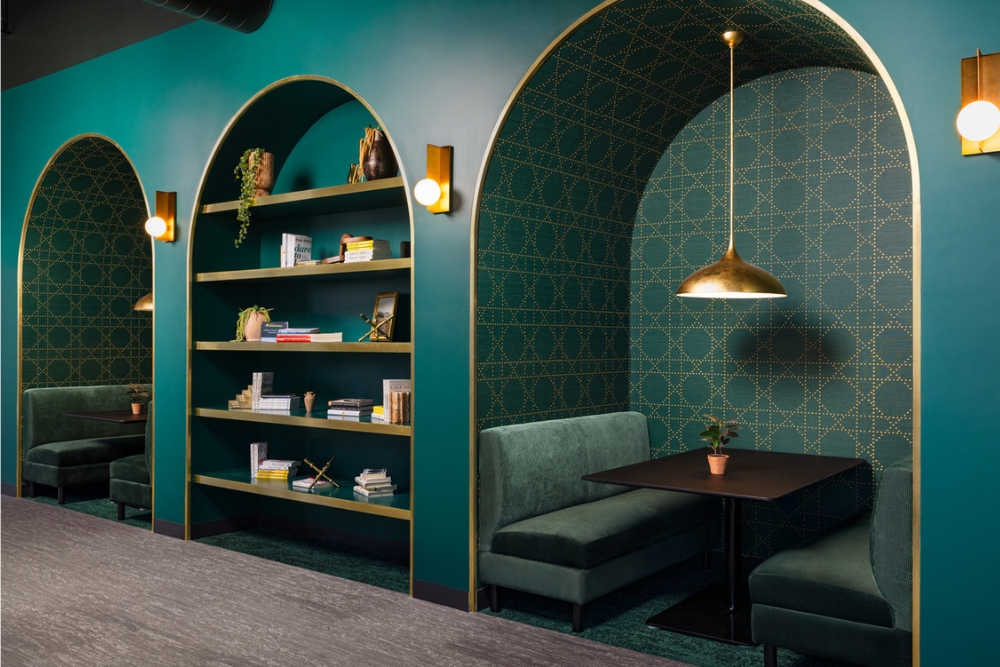
Each office begins with the same arrival sequence and progression through shared and focused spaces, but each city introduces its own interpretation through elements such as art, lighting, and furniture. Dallas reflects a dusky professional character with organic, textured finishes; Jacksonville draws on warmer tones tied to its landscape and heritage; and Las Vegas introduces a more expressive material language shaped by the city’s contrast and environment. These distinctions don’t change how the workplace functions, but rather how it’s interpreted based on location.
Across all three locations is a design expression that reflects what Power Home Remodeling actually does: The offices feel trustworthy and community-rooted, built with the same care and craft the company brings to the homes it works on. That alignment between business purpose and physical environment is what ultimately gives the portfolio its coherence. The offices don’t just share spaces; they share a sense of who the company is and what it stands for.
Designing Culture at Scale
This model allows workplace design to operate at the intersection of organizational culture and local context. As portfolios expand and businesses evolve, each office becomes part of a larger narrative that extends across cities and regions. This approach holds the narrative together with principles that establish a cohesive way of working, while atmosphere and expression support a sense of place. These layers shape environments that are aligned in intent, yet differentiated in experience, creating a balance between continuity and variation that supports clarity throughout the organization and depth within each location.

Ashlee Abdel-Rahman is an associate and workplace designer at Arcadis.