
That’s right, 24% of under or unoccupied office space will be blasting air conditioning for nobody this summer. At the end of each day, these same vacant, cooled spaces and unused bathrooms will be cleaned by the maintenance crew. The obvious contributing factors are summer vacations, hybrid schedules, and team outings. The less obvious and perhaps more insidious issues of unexpected underoccupancy lead to building degradation, equipment strain, and higher costs.
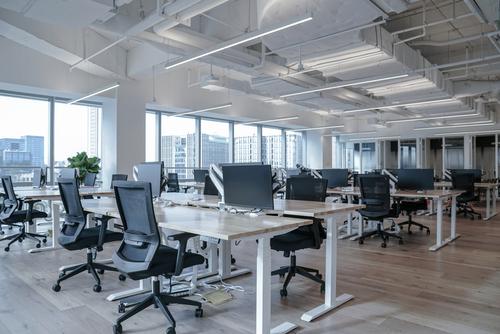
These insights, extracted from a recent workplace survey by Wakefield Research for Butlr, provide a view into the factors driving up facilities management and maintenance expenses. Of course, reducing building costs remains top of mind for decision makers, as the survey found 62% believe better insight into building utilization could deliver measurable savings.
The office optimization issue is not new and occurs throughout the year. However, it becomes more apparent during the summer. When workers are in the office, there are increased calls to facilities management because the office is too hot, too cold, and definitely not just right. Still, another factor sneakily driving up facility costs and undermining workforce productivity is the impact of the sun on the office.
Let me explain. Everybody loves a longer, sunny day. Except when the stronger sun angles penetrate a building’s exterior glass, elevating indoor temperatures. Not to mention sun glare on computer screens. Employees, while waiting for a facilities team member to adjust the air conditioning, vacate their desks and temporarily relocate to another part of the office. They may take over conference rooms, empty desks, or the cafeteria. Or leave the building altogether.
The Hidden Costs of Underutilized Offices
The cost of these seemingly innocuous workforce actions is high. When space is not used for its original intent, as is the case when one person takes over a conference room for focused work, or the cafeteria becomes the unofficial team huddle area, it puts unnecessary strain on the building. Rooms built for 12 are cooled and heated for one while cleaning crews work overtime to keep up with the late afternoon mess in the cafeteria.
To further put the costs into context, a March 2026 JLL report finds that between 2020-2025, U.S. commercial electricity prices increased approximately 33% and demand is expected to increase 25% by 2030. For older facilities with aging infrastructure, high energy demands lead to more frequent outages. This point is backed by the U.S. Department of Energy, which reports that blackouts could increase by 100 times in 2030. Further, it is estimated that $100,000 per hour is lost during a power-related outage. From a workforce perspective, the majority of Wakefield survey participants report more efficient workspaces increase productivity, collaboration, and employee retention. Making the most of investments in office infrastructure is critical to landlords, tenants, and the energy grid.
Optimizing the office requires facilities teams have better insight into how the workforce uses the space. Today, 36% of decisions are based on gut instinct, according to the Wakefield/Butlr survey. A variety of tools are already in place to get office data. This includes occupancy tools and badge swipe intel, but they are limited in their ability to provide comprehensive insight in office usage and infer what is going on throughout the day from a human interaction level.
For example, one Silicon Valley software company was frustrated that only 15% of their workforce was coming into the office. Like many employers, they mandated RTO and kept track of who digitally signed in as proof of physical presence. At first, employees came in daily, but over time, office attendance steadily held at 45% despite warnings from their managers.
To get granular office usage data, the company installed thermal sensors that recognize body heat and movement without the use of cameras. Data from the sensors revealed insights that were not obvious but were costly.
What they discovered was a lot of coffee badging, where employees swipe in but don’t stay for the full day. Also, there were not enough conference rooms and the few they had were never filled. They also learned the cafeteria was being used for late afternoon meetings, forcing the cleaning crew into unexpected overtime.
With a better understanding of how their office was being used, the company changed its layout. The new design resulted in additional, smaller conference rooms, modular pods for private calls and focused work, and restructured maintenance schedules that avoided late-day surprises for cleaners. Two weeks later, workspace utilization was up to 72% and steadily climbed to 90% within six weeks. Additionally, they estimate a savings of $1,400 per restroom per year.
Summer as the Testbed for Year-Round Optimization
Summer presents a great opportunity to experiment with office optimization. By capturing real- time data without personally identifiable information, facilities and maintenance teams can start to see patterns. These patterns correlate to energy demand, space optimization, and office usage. Matching that data with maintenance schedules for crew and equipment leads to more efficient management of time and resources. Ideally, it will also help lower overall infrastructure costs by right-sizing needs instead of relying on time-based scheduling.
Three months is a solid benchmark for understanding office usage and adjusting the office layout and facilities management plans. Over time, more insight enables continuous optimization of the office and employees don’t get unnerved because anonymity is not compromised. Now when office occupancy ebbs and flows, you can prepare accordingly and not be overly concerned with the impact of unoccupied space on the building.
Honghao Deng is CEO and co-founder of Butlr, an MIT Media Lab spinout.