
The global workforce has found its post-pandemic equilibrium, stabilizing around structured hybrid models, according to a new report from JLL. But with hybrid work here to stay, will more organizations turn to artificial intelligence (AI) to boost occupancy planning and management?
JLL’s Global Occupancy Planning Benchmark Report 2026 draws on insights from 84 organizations representing 716 million square feet of portfolios across North America, Latin America, Europe, the Middle East, Africa and Asia Pacific.
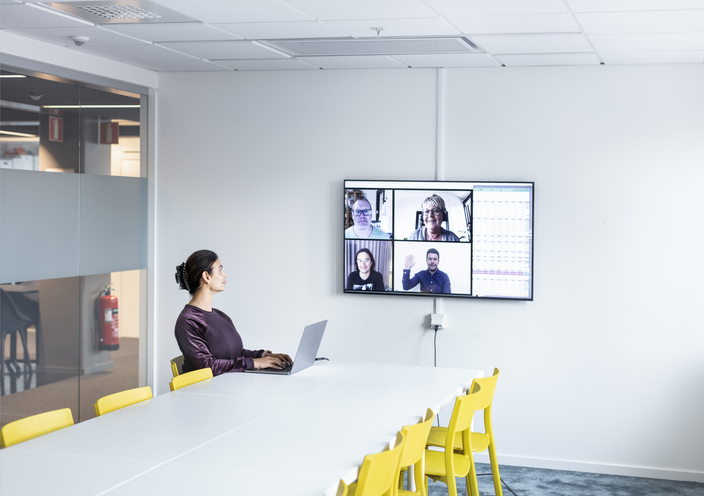
The data signals a decisive shift in how occupiers are returning to the office. The gap between actual and target office utilization has narrowed, decreasing from 25 percentage points in 2025 to 18 in 2026, marking the lowest level recorded since the pandemic. Actual utilization reached 56% globally against a target of 74%, with a dramatic surge in structured mid-week presence as a primary driver. The share of employees attending three to four days per week jumped to over half (55%), up 19 percentage points in a single year, the largest year-over-year shift recorded in three years of benchmark data. In tandem, fully remote work has declined to just 10% of the workforce, down from 18% in 2025.
Structurally, the workplace has found its footing: 62% of organizations now require a fixed number of in-office days, up from 49% just one year ago, as organizations move from encouraging attendance to actively managing it. Enacting office mandates has proven to be an effective lever for improving utilization, with 64% of organizations enacting mandates seeing increases.
From Experiment to Expectation
“The structured hybrid model has moved from experiment to expectation,” said Dr. Paul Morgan, global COO of real estate management services at JLL. “What we’re seeing in 2026 is the maturation of corporate hybrid strategies. Organizations are no longer asking whether employees should come in; they’re actively managing how, when, and in what kind of environment they do.
“The critical challenge now is ensuring that attendance requirements are paired with the change management infrastructure to support them,” Morgan continued. “Our data shows that change management programs have actually declined from 40% to 31% of organizations, even as structured policies have increased. Compliance without engagement is a short-term outcome, and the companies that will win long-term are those investing in the ‘why’ alongside the policy.”
There are also regional considerations at play that organizations must navigate. North and Latin America have consolidated firmly around the three- to four-day model, EMEA remains more divided with a significant share of employees at one to two days per week, and APAC continues to lead full in-office attendance (five days a week) globally, where cultural norms make the office the default rather than the exception.
AI-Readiness: The Next Frontier?
Despite the growing consensus that artificial intelligence will reshape occupancy planning and management, the vast majority of organizations remain at the starting line. Nearly three-quarters (over 70%) of respondents have not yet begun actively piloting, optimizing, or scaling AI solutions for occupancy planning, with 40% not exploring the technology at all. This is underscored by the fact that only 7% of organizations rate their own data capabilities as “excellent.”
The primary barriers to adoption are significant and specific: Data privacy and security concerns top the list at 70%, followed by high implementation costs (46%), and system integration and compatibility challenges (45%). Currently, only 8% of organizations have moved beyond piloting into optimization or scaling.
Matt Quadro, senior director of global occupancy planning at JLL, called the issue a “data quality challenge.” He said, “For organizations preparing to leverage AI in real estate, the reliability of their underlying data will determine the value and accuracy of every insight delivered.”
In addition to being a priority for corporate real estate, utilization data is now applied to 90% of planning decisions globally, up from 70% in 2025. This is particularly important as organizations look to reallocate workspaces in ways that are genuinely useful to the employees. For example, private offices continue their decline as phone booths (41%), focus rooms (30%), and small meeting rooms (29%) rise in their place. Knowing whether those investments are working requires space-level utilization data, not building-level badge counts, according to the report.
The full report is available here.